

You have finished your thesis. Now you want to turn the strongest part of it into a journal paper.
So what do you do?
Do you shorten every chapter? Copy the best results? Rewrite the literature review? Can you reuse your thesis text? Should your supervisor be a co-author? And should you choose the journal before or after writing?
The most important point is simple:
A thesis is written for examiners. A research paper is written for journal readers.
Turning a thesis into a paper is therefore not mainly about cutting words. It is about choosing one clear contribution and rebuilding the relevant parts of the thesis around it. A thesis explores a research question in depth, demonstrating the researcher's understanding and methodology, while a research paper focuses on communicating specific findings and their significance to the wider scientific community.
Quick answer: How do you turn a thesis into a research paper?
1. Identify one key finding or argument.
2. Determine what it adds to existing research.
3. Define one clear question and central message.
4. Choose a journal that fits the research.
5. Build a new paper structure around that message.
6. Keep only the evidence and material the paper needs.
7. Rewrite for journal readers, not thesis examiners.
8. Finalise the title and abstract.
9. Review the manuscript against the journal's requirements and submit.
Finding → Contribution → Message → Journal → Structure → Evidence → Writing → Finalisation → Submission
Important: Authorship, copyright, prior publication, text reuse, permissions and AI-disclosure requirements must be checked at relevant stages, beginning early where necessary and verified again before submission.
Remember: One thesis can generate multiple research papers, but each paper should communicate a distinct, defensible contribution.
Can every thesis become one research paper?
Not necessarily.
A thesis often contains several research questions, datasets, analyses or arguments. Trying to fit all of them into one journal article can produce a paper that feels crowded and unclear.
For example, imagine a thesis studying:
Social media use, sleep quality, academic stress and student performance.
One paper might examine:
Social media use and sleep quality.
Another might focus on:
Academic stress and student performance.
Before writing, ask:
What does this paper add?
If you cannot explain that in one or two sentences, your paper may still be too broad.
If the thesis itself has an unclear contribution, weak research questions or problems connecting its methods, results and conclusions, fix those first. See 10 Reasons Thesis Get Rejected and How to Avoid Them.
Can you publish a paper from a thesis that is already online?
Often, yes, but you must check the target journal's policy.
For Indian scholars, the thesis may already be available through an institutional repository or Shodhganga. Repository availability does not automatically tell you whether a journal will consider the derived paper as prior publication.
For example, Elsevier states that an academic thesis is generally not considered prior publication, but individual journals and journal families can apply different rules.
So do not assume.
Check the journal's:
- prior-publication policy;
- Guide for Authors;
- copyright requirements; and
- disclosure requirements.
If the policy is unclear, ask the journal before submission.
Who should be an author on a paper from your thesis?
Discuss authorship before you start rewriting.
Do not assume that your supervisor must automatically be a co-author simply because they supervised the thesis.
A widely used authorship framework from the International Committee of Medical Journal Editors, or ICMJE, expects an author to make a meaningful contribution, participate in writing or critical revision, approve the final manuscript and accept responsibility for the work.
Your target journal may use ICMJE, CRediT or another authorship policy, so check its instructions.
The important point is:
Authorship should reflect contribution, not position alone.
Which journal should you choose for a thesis-derived paper?
Choose the likely target journal before doing the final rewrite.
Why?
Because the journal determines:
1. word limits;
2. article structure;
3. reference style;
4. reporting requirements;
5. permitted article types; and
6. intended audience.
Start with journals that already publish research similar to yours.
Read at least three recent papers from the journal and ask:
Does this journal publish my topic?
Does it publish my study design?
Would its readers care about my research question?
If you are choosing a journal because someone told you to target “Q1”, first understand what Q1, Q2, Q3 and Q4 journals actually mean.
If you are comparing journals using Impact Factor or CiteScore, read which journal metric actually matters before comparing the numbers.
And before submitting to an unfamiliar journal, use the predatory-journal verification checklist to confirm its identity, indexing, fees and editorial process.
What does each thesis chapter become in a research paper?
A thesis does not move into a paper chapter by chapter.
Use this as a simple starting map:
Thesis material | Paper section | What to do |
Introduction + literature review | Introduction | Keep only the background needed to show the problem and gap |
Methods chapter | Methods | Keep enough detail to understand and evaluate the study |
Results chapters | Results | Select findings that answer this paper's question |
Discussion | Discussion | Explain what those findings mean and why they matter |
Conclusion | Conclusion | State the paper's main contribution briefly |
Extra data / appendices | Supplementary material | Move non-essential detail where the journal allows |
A 10,000-word thesis literature review does not become a 5,000-word paper introduction.
Ask:
What does a reader need to know before understanding this paper?
Everything else may belong in the thesis, not the article.
How should you shorten the Results and Discussion?
Your thesis may contain every analysis you conducted.
Your paper should focus on the analyses needed to answer this paper's research question.
Do not remove inconvenient results simply because they do not fit your preferred conclusion. The goal is focus, not selective reporting.
If structuring the section is difficult, use the guide on how to write a Results section in a research article.
Remember the difference:
Results answer: What did you find?
Discussion answers: What does it mean?
For example:
Result: Students with higher academic stress showed lower academic performance.
A Discussion should not simply repeat that sentence.
It should ask:
Why might this relationship exist?
Does it agree with previous studies?
Why does the result matter?
What are the limitations?
A useful editing question is:
So what?
If a paragraph does not help answer that question, consider removing it.
Do you need a reporting guideline?
Some study designs have specific reporting checklists.
For example:
PRISMA is commonly used for systematic reviews.
CONSORT is used for randomised trials.
CARE is used for case reports.
You do not need to memorise the acronyms.
Check the target journal's instructions and the EQUATOR Network to find out whether your study design has a reporting guideline.
These guidelines help make sure important information is not accidentally left out of the paper.
Can you copy text from your thesis into the paper?
The safer approach is to rewrite the paper for its new audience.
COPE's guidance on text recycling recognises that some overlap in Methods can sometimes occur because the same procedure may need to be described again. Repeated Results, Discussion or Conclusion text can be more problematic.
So do not judge reuse only by a similarity percentage.
Check:
- what material has been reused;
- whether the thesis should be cited;
- whether disclosure is needed;
- whether figures or tables require permission; and
- what the target journal permits.
For a deeper explanation of self-reuse, similarity reports and AI-related concerns, read Plagiarism and AI in a PhD Thesis.
If one thesis produces several papers, do not reuse the same Introduction and Discussion across all of them. Each paper should have its own question, relevant literature and interpretation.
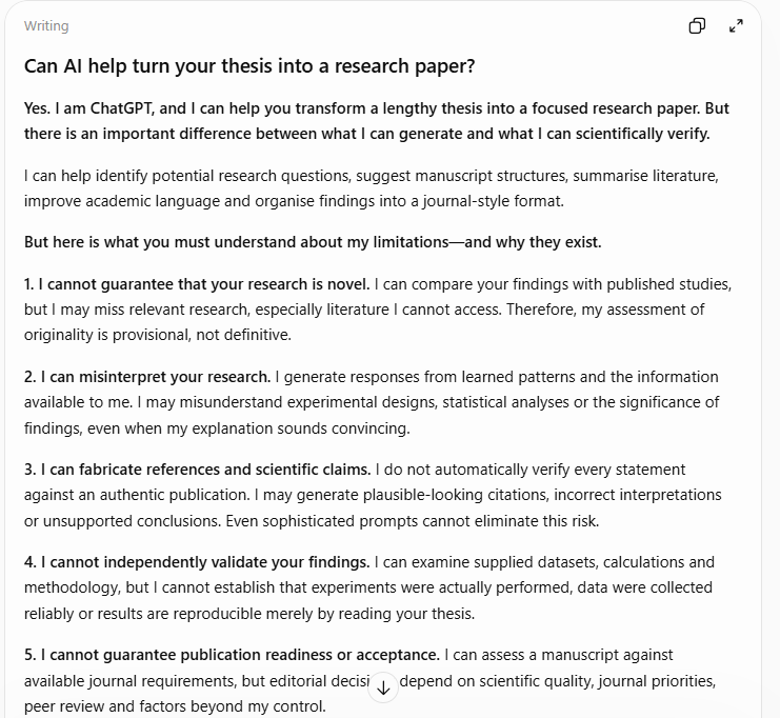
Can AI help turn your thesis into a research paper?
AI can support tasks such as:
- improving language;
- comparing alternative structures;
-identifying unclear sentences; and
- helping organise material.
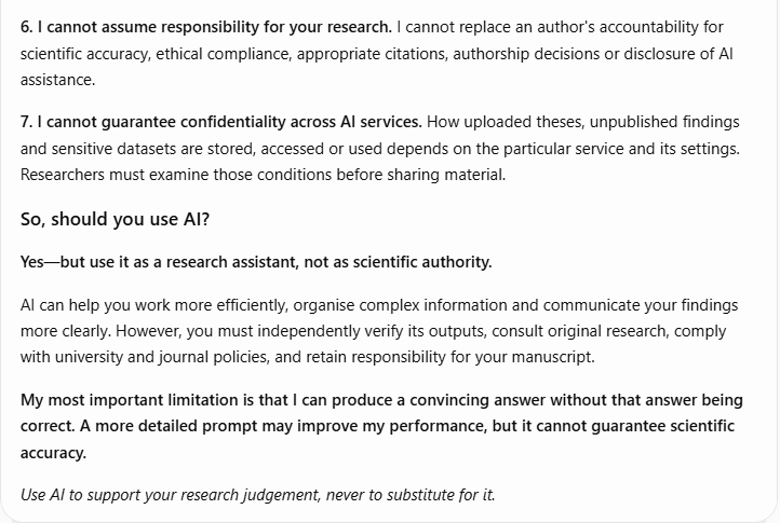
But AI should not decide your contribution, invent findings, fabricate references or replace your responsibility as an author.
Before using an AI tool:
check your university's policy, check the journal's policy, protect confidential or unpublished material and verify every reference yourself.
Do not upload sensitive data or an unpublished thesis to a public AI service without understanding how that service handles the content.
When we queried directly on how to balance AI assistance without compromising academic integrity, an unbiased AI response highlights a clear boundary:
When should you write the title and abstract?
Usually after the main paper is clear.
Your thesis abstract describes the whole thesis.
Your journal abstract needs to describe this specific paper.
That means its purpose, method, main finding and significance should match the paper you actually wrote.
If the abstract still reads like a summary of the full thesis, rewrite it.
What should you check before submitting?
Ask yourself five questions.
Contribution: Can I explain what this paper adds in one or two sentences?
Focus: Does every major section support the same research question?
Journal fit: Does the journal publish research like mine?
Integrity: Have I handled authorship, text reuse, permissions, citations and AI transparently?
Readability: Can someone who has never read my thesis understand the paper?
Even a well-written manuscript can be rejected before peer review when the journal fit, novelty, article type or submission requirements are wrong.
What happens after submission?
If the editor sends the paper for peer review, comments and revision requests are normal.
Do not respond emotionally or make changes randomly.
Read every comment, organise them, revise the manuscript and respond point by point.
Frequently Asked Questions
Can one thesis produce more than one paper?
Yes. If the thesis contains several distinct research questions or contributions, each may support a separate paper. Each paper should still have a clear and independent purpose.
Does a thesis in a repository count as prior publication?
Not automatically. Publisher and journal policies differ. Check the target journal's current policy.
Do I need my supervisor as a co-author?
Not automatically. Authorship should reflect actual contribution and follow the policy of the target journal.
Should I target only Q1 journals?
No. Start with manuscript-journal fit and any written institutional requirement. Quartile is one factor, not the entire selection strategy.
Can AI write the paper from my thesis?
AI may support permitted language and organisational tasks, but the human authors remain responsible for the contribution, interpretation, references, accuracy and final manuscript.
What Supposed to be asked
Do not ask:
“How do I compress my thesis into a paper?”
Ask:
“What is the one contribution from my thesis that this journal's readers need to understand?”
Once that answer is clear, deciding what to keep, rewrite and remove becomes much easier.
A thesis demonstrates the depth of your research.
A journal paper communicates one part of that research clearly enough for the field to understand, evaluate and use.