
Understanding Plagiarism and AI in Research Writing
REALITY
Let’s be honest: research writing already feels hard enough without adding one more layer of anxiety. First, you have to make sense of the literature. Then you need to structure your argument, cite sources correctly, and write in a way that sounds clear, original, and academically sound. Now, on top of all that, researchers are also asking a new question: where does AI fit into all of this?
For many students, faculty members, and early-career researchers, the real fear is not just “Will this sound good?” but “Will this be flagged?” That is why searches for terms like plagiarism checker, AI checker, AI detection, and research ethics are growing so quickly. People are not only looking for tools. They are looking for clarity.
The truth is that plagiarism and AI are connected, but they are not the same thing. A text can be fully human-written and still be plagiarized. A text can also involve AI support without automatically becoming unethical. What matters is how the writing was created, how ideas were sourced, and whether the final manuscript reflects honest scholarship. In research writing, integrity is not optional. It is the foundation of trust.
What plagiarism really means in research writing
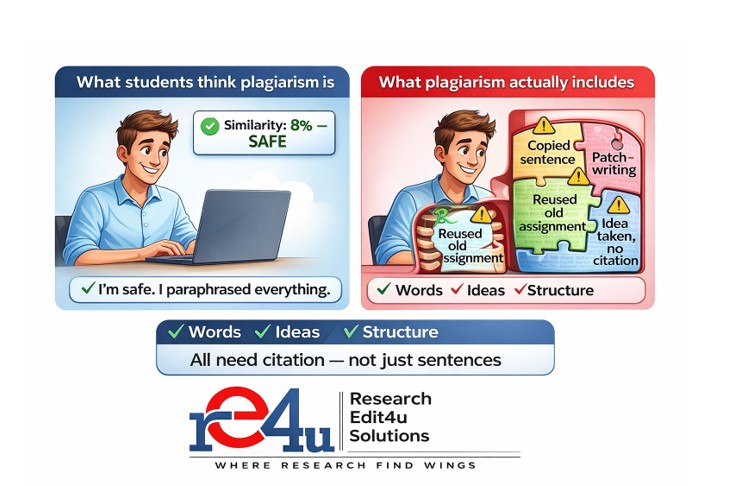
At its simplest, plagiarism means presenting someone else’s words, ideas, data, or structure as your own without proper acknowledgment. Most people think only of copy-pasting, but research plagiarism is broader than that. It can include unattributed paraphrasing, patchwriting, recycled text from earlier submissions, and even borrowing the logic or framing of another paper too closely.
In academic settings, plagiarism is not only a language issue. It is an authorship issue. A plagiarism checker may help identify matching text, but it cannot always detect intellectual dependence, misleading attribution, or weak paraphrasing. That is why understanding plagiarism meaning and plagiarism types matters far more than simply running a similarity check at the end.
For researchers, the biggest risk often comes from pressure. Tight deadlines, language barriers, publication expectations, and fear of rejection can push writers toward shortcuts. But what feels like a quick fix can damage credibility, delay publication, or trigger research misconduct concerns later.
The most common types of plagiarism researchers should watch for
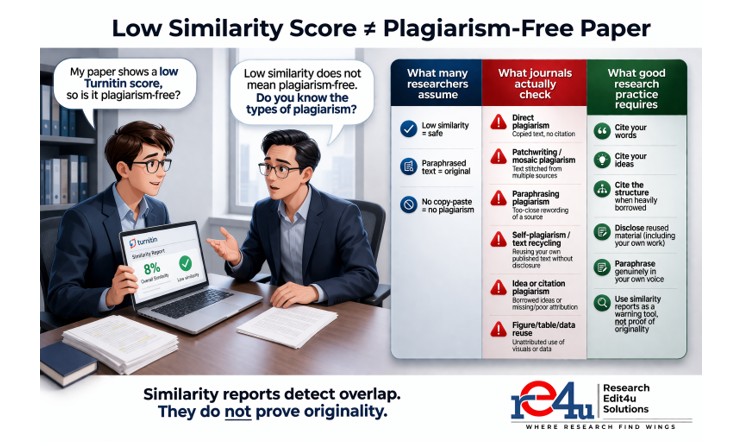
Direct plagiarism is the easiest to recognize: copied text with no citation. But self plagiarism is often more confusing. This happens when an author reuses substantial parts of their own previously submitted or published work without appropriate disclosure. In thesis chapters, conference papers, review articles, and derivative manuscripts, this is a common gray area.
Paraphrasing plagiarism is another major issue. This happens when a source is lightly rewritten but the sentence structure, logic, or wording remains too close to the original. Many writers assume that replacing a few words is enough. It is not. Good paraphrasing requires genuine re-expression and proper citation.
Then there is citation plagiarism, where a source influences the writing but is either cited incompletely or not cited where it actually shaped the argument. In research writing, small citation gaps can create big integrity issues. That is why academic integrity is built not only through originality, but through transparent attribution.
Can AI-generated writing be plagiarism?
This is the question everyone is asking, and the answer requires nuance. AI-generated writing is not automatically plagiarism, but it can lead to plagiarism very easily. If a researcher pastes AI output directly into a manuscript without checking facts, rewriting for context, or verifying originality, the result may contain recycled phrasing, fabricated references, or unintentional overlap with published text.
AI tools also create a false sense of safety. Because the wording looks polished, users may assume the content is trustworthy. But polished language is not the same as original scholarship. If an AI tool produces a literature summary, methodology explanation, or discussion paragraph, the researcher is still responsible for validating every claim, adding domain-specific interpretation, and ensuring proper citation.
The better question is not “Can I use AI?” but “How am I using AI?” If AI is being used to brainstorm structure, improve readability, simplify grammar, or generate revision options, it can support the writing process. If it is being used to replace thinking, source engagement, or authorship, then the risk becomes ethical as well as editorial.
AI checker vs plagiarism checker: what is the difference?
A plagiarism checker is designed to identify text overlap between a document and other indexed sources. It helps estimate similarity, highlight matched passages, and flag areas that may need citation, quotation, or stronger paraphrasing. This makes it useful for checking plagiarism before submission, especially in academic writing and thesis writing.
An AI checker, by contrast, attempts to predict whether text appears machine-generated. That sounds helpful, but these systems are far less reliable than many people assume. False positives are common, especially with formal academic prose, non-native English writing, and highly structured texts. This is why AI score reports should never be treated as definitive proof of misconduct.
For researchers, the practical takeaway is simple: a plagiarism report can be a useful diagnostic tool, but it is not the same as a judgment of ethics. An AI checker can raise questions, but it cannot replace human review. Neither tool should be used in isolation. The strongest safeguard is still careful drafting, source transparency, and informed editorial review.
How to reduce plagiarism without damaging your voice
The goal should never be to ‘beat’ a checker. It should be to write in a way that is genuinely original, traceable, and defensible. Start by taking notes in your own language while reading sources instead of copying chunks into your draft. When you paraphrase, step away from the source, restate the idea from memory, and then verify accuracy before citing it.
Second, separate source-supported statements from your own interpretation. Many manuscripts become patchy because writers mix borrowed background with original analysis in the same sentence. Clear separation improves both readability and originality. Third, run a similarity check early rather than only at the end. That gives you time to revise structurally instead of making rushed cosmetic edits.
Finally, use editing support wisely. Language polishing, structure review, and publication-focused feedback can strengthen a manuscript without compromising authorship. Good support does not write the science for you. It helps you express it clearly, ethically, and in a form that stands up to peer review.
The ethical way to use AI in academic writing
Ethical AI use starts with disclosure, judgment, and restraint. Researchers should follow institutional and journal guidance, especially where publication ethics or AI disclosure policies apply. Some journals permit limited language assistance but do not allow AI tools to be credited as authors or to generate unverified scholarly claims.
A practical rule is this: if AI helps you improve expression, you still own the argument. If AI shapes the argument, sources, or evidence, you need to slow down and review whether you are crossing an authorship boundary. Research ethics is not about rejecting technology completely. It is about preserving accountability.
In the end, readers, reviewers, and editors are not only evaluating whether a manuscript sounds polished. They are evaluating whether it reflects responsible scholarship. And that is why the future of research writing will not be decided by better tools alone. It will be decided by better habits.
Quick answers for featured snippets and answer engines
Question | Concise answer |
What is plagiarism in research writing? | Plagiarism in research writing is using someone else’s words, ideas, data, or structure without proper acknowledgment. |
Is AI-generated text considered plagiarism? | Not automatically, but it can become plagiarism if it reproduces existing content, lacks verification, or is used without proper scholarly responsibility. |
What is the difference between an AI checker and a plagiarism checker? | A plagiarism checker looks for text overlap with other sources, while an AI checker estimates whether text appears machine-generated. |
How can researchers reduce plagiarism? | Researchers can reduce plagiarism by taking original notes, paraphrasing properly, citing accurately, and checking similarity before submission. |
Conclusion
If there is one thing researchers should remember, it is this: plagiarism is not just about copied text, and AI is not just about convenience. Both raise deeper questions about originality, accountability, and trust. The safest path is not fear-based writing. It is informed writing. When you understand plagiarism clearly, use AI carefully, and build your manuscript around ethical research habits, you create something stronger than a low similarity score - you create work that can be defended with confidence.