
How to Spot a Predatory Journal Before You Submit: 2026 Verification Checklist
A journal can look professional, display an ISSN, claim Scopus or Web of Science indexing, promise rapid publication, and still leave you with serious questions about its credibility. The safest time to resolve those questions is before you upload your manuscript, pay a fee, or commit to a publication route.
You do not need to decide whether a journal is “predatory” from one sign. You need a repeatable way to verify what the journal claims, how it publishes, and whether it is suitable for your academic purpose. This guide turns that due diligence into a practical workflow you can use before submission.
Quick answer
A predatory or deceptive journal is not simply a journal that charges an article processing charge (APC). The stronger warning pattern is deception or poor transparency: misleading information, unverifiable indexing claims, unclear editorial practices, hidden fees, aggressive solicitation, or acceptance processes that do not resemble credible scholarly review. A 2019 international consensus definition similarly emphasised self-interest, misleading information, deviation from good editorial practice, lack of transparency and aggressive solicitation.
Start with your situation
Do not read this page from top to bottom if you do not need to. Use the route that matches where you are now.
Your situation | Go to | What you will get |
I have not submitted yet | The 3-gate verification pathway | Ten checks to verify the journal before submission. |
I received a very fast acceptance or unexpected invoice | If you are already past the pre-submission stage | A short before-you-pay recheck. |
I already submitted and now have concerns | If you are already past the pre-submission stage | Immediate steps to preserve evidence and clarify manuscript status. |
The 3-gate journal verification pathway
Think about journal verification in three stages: first verify what the journal claims to be; then assess whether its publishing process is transparent; finally check whether it actually fits your manuscript and institutional requirements.
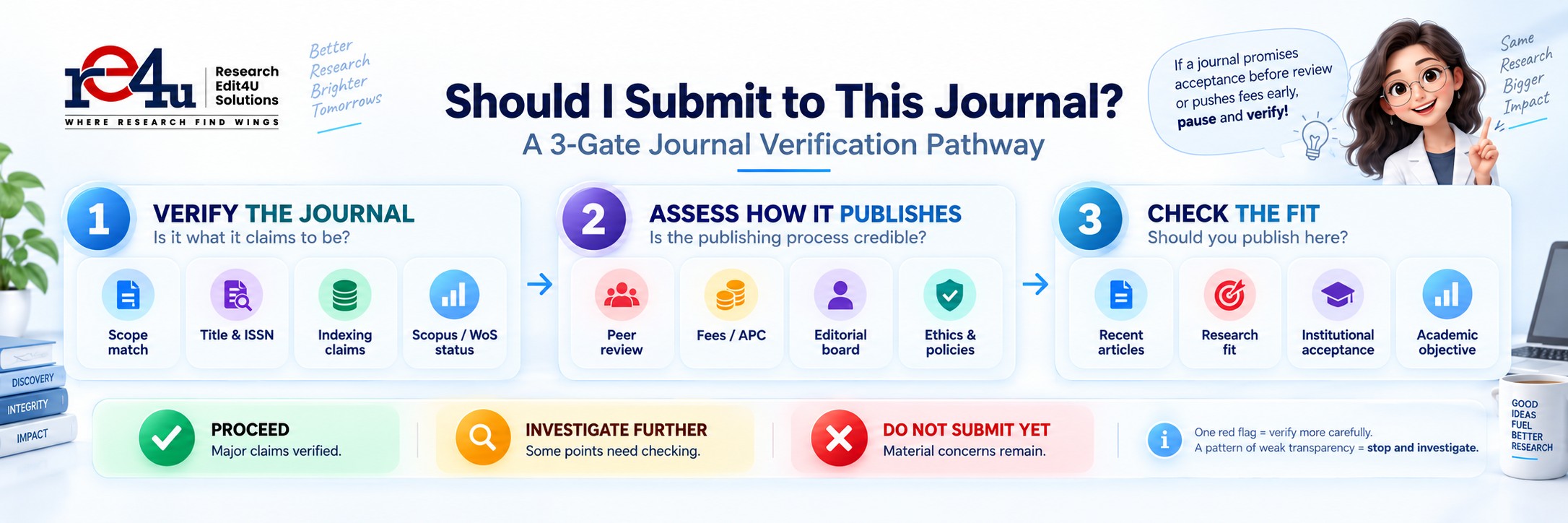
Figure 1. A three-gate journal verification pathway: verify the journal, assess how it publishes, then check the fit before deciding.
Gate 1 : Verify the journal
The first question is simple: is the journal what it claims to be?
1. Compare the stated scope with recently published papers
Read the aims and scope, then open several papers from recent issues. The topics should make sense for the journal’s stated field. A journal that claims to cover almost every discipline deserves closer scrutiny unless it is genuinely multidisciplinary.
Verify at: Aims and scope + recent issues
Stop and investigate if: A broad or inconsistent scope that does not match what the journal actually publishes.
2. Confirm journal identity and ISSN
Check the exact title, publisher, website domain and ISSN. Use the ISSN Portal to confirm identity information and whether print/online identifiers are consistent. An ISSN identifies a continuing publication; it is not a quality certificate.
Verify at: ISSN Portal + publisher/journal website
Stop and investigate if: Conflicting title, publisher, domain or ISSN information.
3. Ask how you found the journal
Unsolicited invitations are not automatically evidence of misconduct, but the discovery route matters. Be cautious when an email uses excessive praise, urgency, a topic unrelated to your work, guaranteed publication, or pressure to submit immediately.
Verify at: The original invitation/email + journal website
Stop and investigate if: Praise, urgency or promises that seem designed to bypass normal evaluation.
4. Verify indexing claims outside the journal website
Do not treat a database logo as proof. Search the official source named by the journal: Web of Science Master Journal List for Web of Science claims, DOAJ for relevant open-access claims, and the appropriate source information for other databases.
Verify at: Official database named in the claim
Stop and investigate if: A badge or statement that cannot be confirmed in the official database.
5. Check current Scopus or Web of Science status
Current status matters. Search by exact journal title and ISSN where possible. Scopus notes that source information is updated and that discontinued titles remain identifiable, so being indexed at some point in the past is not the same as having current coverage.
Verify at: Scopus Sources / source-title information + Web of Science Master Journal List
Stop and investigate if: A journal presenting historical or discontinued coverage as if it were current.
Gate 2 : Assess how the journal publishes
A legitimate-looking identity is not enough. The journal also needs a credible, transparent publishing process.
6. Read the peer-review policy
A credible journal should explain whether articles are peer reviewed, the review model used, and how editorial decisions are made. The transparency principles developed by COPE, DOAJ, OASPA and WAME state that journals should clearly describe their peer-review process.
Verify at: Peer-review policy + recent decision/revision patterns where available
Stop and investigate if: Guaranteed acceptance, implausibly short review with no explanation, or acceptance without meaningful editorial/reviewer feedback.
7. Check fees and APCs before submission
An APC does not make a journal predatory. The issue is transparency. Publication fees, waivers and other author charges should be discoverable before submission. A fee that appears only after acceptance or a previously undisclosed withdrawal charge requires investigation.
Verify at: Author fees/APC page + submission instructions
Stop and investigate if: Hidden, late-disclosed or pressured payment demands.
8. Verify the editorial board
Look for names, affiliations and subject expertise. Independently check a sample of members through institutional pages, ORCID, Google Scholar or other professional profiles. A prestigious-looking list is not useful if the people cannot be connected to the journal.
Verify at: Journal editorial-board page + independent professional/institutional profiles
Stop and investigate if: Unverifiable affiliations, mismatched expertise or people who cannot be connected to the journal.
9. Check website policies, ownership, contact details and archive
The journal should identify who owns or manages it and provide credible contact information. Look for policies on authorship, conflicts of interest, plagiarism, corrections, retractions, complaints and misconduct. Check whether recent issues, article dates, affiliations, references and DOI information are coherent. If COPE membership is claimed, verify it independently.
Verify at: Journal policies and archive + COPE member information + recent articles
Stop and investigate if: Vague ownership, copied/inconsistent information, missing core policies, broken archives or publication metadata that does not make sense.
Gate 3 : Check whether the journal fits your academic goal
10. Check institutional fit, readership and your real publication objective
A journal can be legitimate and still be wrong for your paper. Check scope fit, target readership, indexing requirements, turnaround expectations, publication fees and your university or funder’s current rules. Also question unfamiliar metrics or awards. Recognised journal metrics have identifiable providers and methods; labels such as “international”, “global”, “ISI”, “indexed” or “high impact” should take you to an authoritative source, not end the verification process.
Verify at: Your institution/funder requirements + official indexing/metric providers + the journal’s own current policies.
Stop and investigate if: The journal cannot satisfy the requirement you actually need, or relies on unfamiliar metrics and old approvals as its main proof of credibility.
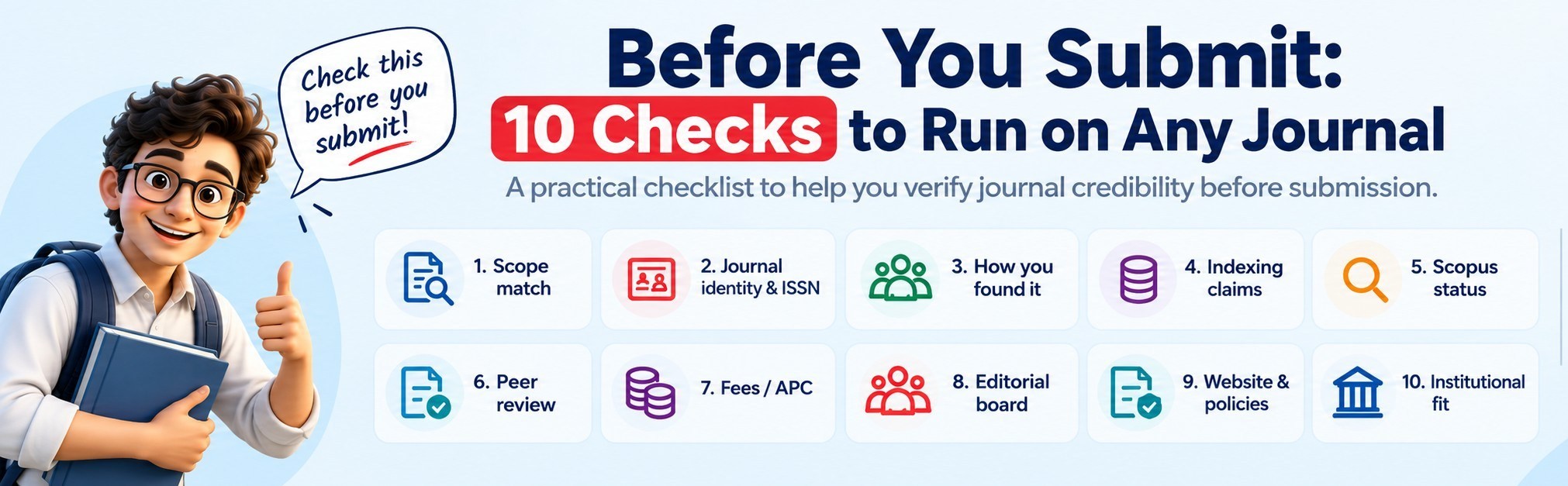
At a glance: the 10 checks
If you are screening several journals, use this visual as the fast recap. The sections above explain what each check means and where to verify it.
Do not diagnose a journal from one red flag, look for a pattern
One unclear item is a reason to verify more deeply, not automatically to label a journal predatory. Concern becomes stronger when several problems appear together.
Pattern | What it can look like |
Pressure | Unsolicited praise, urgency, guaranteed publication, pressure to submit/revise/pay immediately or recruit colleagues. |
Unverifiable claims | Indexing, metrics, institutional affiliations or editorial-board claims that cannot be confirmed independently. |
Hidden money | APCs, membership charges or withdrawal fees that were not clearly disclosed before submission. |
Opaque publishing process | Unclear peer review, vague contact information, missing policies, contradictory publisher details or acceptance without credible review. |
Download the Journal Verification Checklist and use the same ten checks for every shortlisted journal. Consistency is more useful than relying on a single badge, list, metric or recommendation. |
For researchers in India: UGC-CARE is no longer a current approval list
Old advice still circulates online. In February 2025, the University Grants Commission decided to discontinue UGC-CARE journal listing. In July 2025, UGC approved suggestive parameters for choosing peer-reviewed journals and uploaded the former CARE list of 1,474 journals only as a reference resource. UGC stated that inclusion or exclusion from the archived list does not imply validation or endorsement.
The current parameter-based approach focuses on checks such as journal title and ISSN, regular publication, transparent review policy, access and fee policy, archival policy, editorial-board details, APC transparency, publishing timeline, ethics, website quality, citation information and indexing in reputed databases.
India-specific takeaway If a journal says “UGC approved” or relies mainly on an old UGC-CARE status, do not stop there. Verify the journal under current institutional requirements and the UGC’s present parameter-based approach. |
Where should you verify a journal’s claims?
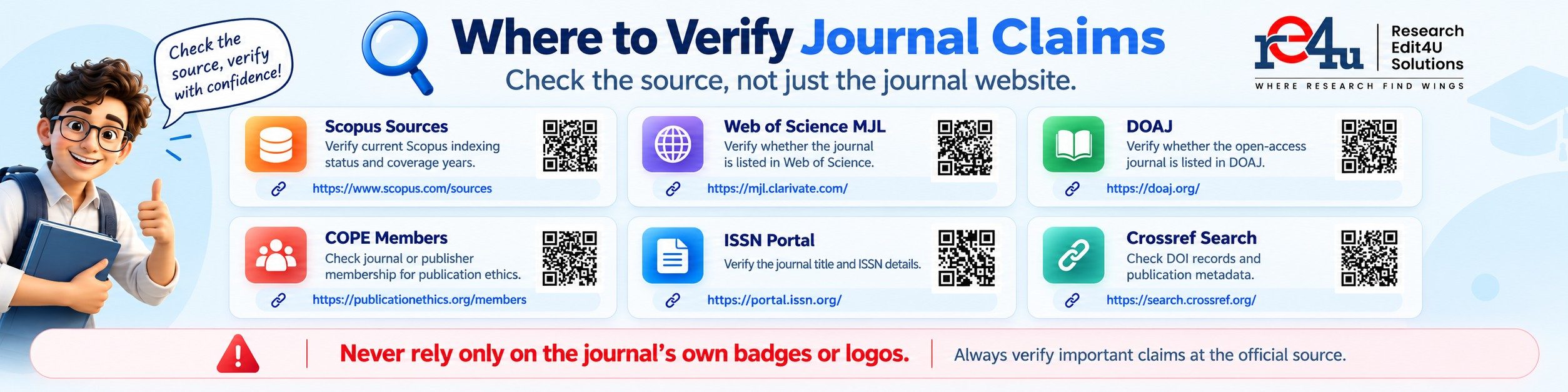
Use primary or authoritative databases whenever a journal makes a specific claim. Search by exact title and ISSN where possible. Each source answers a different question.
Scopus Sources / source-title information: Confirm current Scopus source information and identify discontinued-title information.
Web of Science Master Journal List: Verify Web of Science coverage claims.
DOAJ: Verify relevant open-access inclusion and transparency-related information.
COPE member information: Verify a claimed COPE membership. Non-membership alone does not prove a journal is predatory.
ISSN Portal: Verify title/ISSN identity and related publication information.
Crossref Metadata Search: Inspect DOI metadata and search works by journal title or ISSN. This is a metadata check, not a quality certificate.
Make a three-way decision: Submit, Investigate Further, or Avoid for Now
Do not force every journal into a simple “predatory/not predatory” label. A decision framework is more useful and fairer to legitimate small or newer journals.
SUBMIT | INVESTIGATE FURTHER | AVOID FOR NOW |
The journal fits your manuscript; identity and indexing claims are independently verifiable; policies, fees and editorial process are transparent. | One or more important items are unclear for example, a board member cannot be verified, database status is ambiguous, or the fee policy is incomplete. Ask questions before submission. | You find multiple deceptive or contradictory claims, hidden charges, pressure tactics, unverifiable indexing or an editorial process that cannot be explained credibly. |
Good journal selection is due diligence, not label hunting.
If you are already past the pre-submission stage
Received an unusually fast acceptance or unexpected invoice?
An acceptance email alone is not proof of a problem, and legitimate journals can sometimes review efficiently. Re-check the journal before paying if several warning signs occur together: unusually rapid acceptance, little or no meaningful reviewer feedback, a fee that was not clearly disclosed before submission, pressure to pay quickly, or an unclear withdrawal policy.
-Was the APC or other charge clearly disclosed before submission?
-Did you receive a credible editorial decision and, where appropriate, reviewer comments?
-Can you independently verify the journal’s identity and current indexing claims?
-Does the journal publish a clear fee, refund and withdrawal policy?
Before you pay Pause, preserve the message, verify independently, and ask for clarification in writing. A payment or contractual dispute may require institution-specific or qualified legal advice; a general blog cannot determine your legal obligations. |
Already submitted to a suspicious journal?
The immediate objective is to establish the manuscript’s status and preserve evidence without creating a second publication problem.
1. Save the submission confirmation, emails, invoices, reviewer comments and screenshots of relevant policies.
2. Check whether the manuscript is only submitted, formally accepted, published online or assigned a DOI.
3. Review the withdrawal and fee policies that applied when you submitted, if you can document them.
4. Ask the editorial office for clarification in writing.
5. Inform your supervisor, co-authors or research office if the manuscript is linked to a degree, grant or institutional obligation.
6. If you decide to withdraw, send a clear written request and keep the response.
7. Do not submit the same manuscript elsewhere while the first submission remains active or its status is unclear.
If the situation involves threats, payment disputes, unauthorised publication or uncertainty about copyright, obtain institution-specific or legal advice. The correct response depends on the documents you agreed to and the manuscript’s current publication status.
Frequently asked questions about predatory journals
-Is every journal that charges an APC predatory?
No. Legitimate open-access journals may charge APCs. The important questions are whether fees are transparent, the editorial process is credible, and the journal follows clear scholarly-publishing policies.
-Does an ISSN prove a journal is legitimate?
No. An ISSN identifies a serial publication; it is not a quality rating. Use it to confirm identity, then perform the other checks in this guide.
-If a journal is in Scopus, is it automatically safe?
Scopus coverage is a useful signal, but you should still verify the exact title and current source status. Journal suitability also involves scope, policies, peer review, fees and institutional requirements.
-Is UGC-CARE still used as an approved-journal list in India?
No. UGC discontinued the CARE listing in 2025. The archived list is available for reference, but inclusion or exclusion does not constitute validation or endorsement. Researchers should use current parameters and institutional rules.
-Should I use a public blacklist of predatory journals?
Treat any list as a starting clue, not final proof. Journal practices and indexing status change, and labels can be disputed. Current verification from primary sources is safer than relying on one static list.
-Can RE4U guarantee that a journal will accept my manuscript?
No credible publication-support service can guarantee editorial acceptance. Journal vetting can reduce avoidable risk by checking fit, transparency, indexing claims, fees and other credibility signals before you submit.
Verify before your manuscript, money and deadline are exposed
The best time to identify a risky journal is before submission. At that point, you still control the manuscript, you have not paid a fee, and you can compare alternatives without pressure.
Use the same ten checks for every journal. Verify important claims outside the journal website, keep your academic objective in view, and pause when several concerns appear together. If a journal cannot clearly explain who it is, how it reviews, what it charges, who governs it and where its indexing claims can be confirmed, you have enough reason to investigate before submitting.
Need an independent journal check? RE4U can review a journal or shortlist before submission and document scope fit, current indexing claims, publisher/journal identity, fee transparency, editorial and ethics signals, and potential risk points. Journal vetting reduces avoidable uncertainty; it does not guarantee acceptance or replace your institution’s rules. |