
Q1. What has UGC reportedly said about AI in PhD theses?
Recent reports say UGC has placed unacknowledged AI use in PhD work under plagiarism-style scrutiny. The reported penalty bands include revision for 10–40%, a one-year submission bar for 40–60%, and possible cancellation above 60%. The core message is clear: the thesis must remain the scholar’s own intellectual work; AI may be limited to support such as language correction.
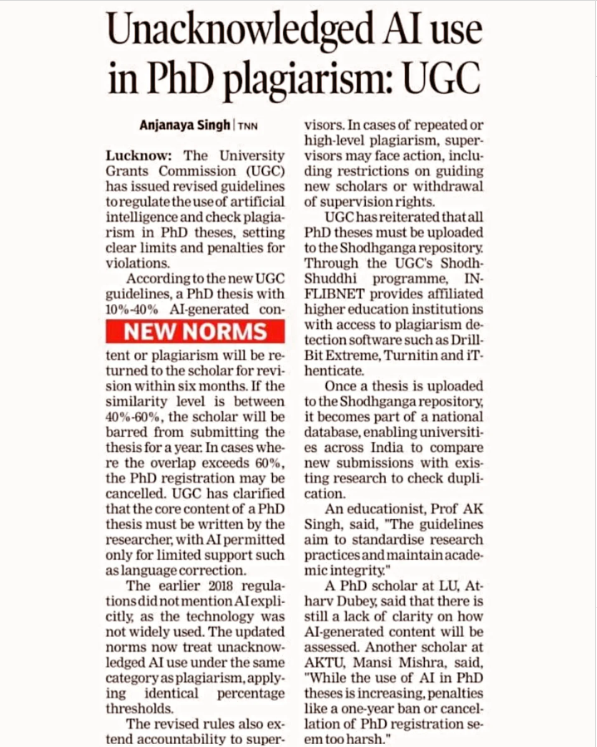
Fig: Revised UGC norms treat unacknowledged AI use as plagiarism in PhD work
Q2. Can PhD students use AI at all?
Yes, but only responsibly and transparently. AI may help with grammar, language polishing, translation support, outlining, coding assistance or readability, depending on institutional rules. It must not become a hidden co-author. Students should not use AI to fabricate data, invent references, replace analysis or outsource interpretation.
Q3. Is a Turnitin report enough to prove integrity?
No. Turnitin’s AI writing report has file requirements, including a maximum of 30,000 words. Many PhD theses are longer. Also, similarity and AI writing scores measure limited signals; they do not prove whether the scholar owns the research question, method, data interpretation and contribution.
Read Turnitin guideline Here
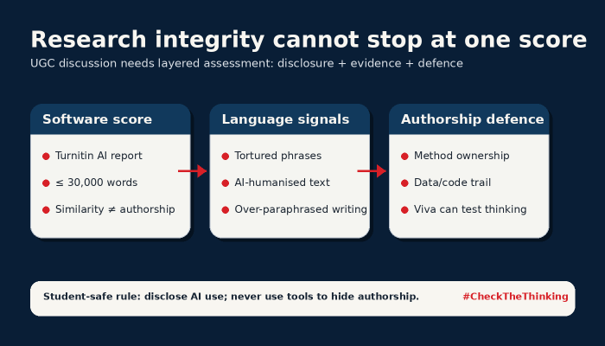
Fig: . Integrity framework: AI checking should combine software signals, language-integrity signals and authorship defence, rather than relying on one percentage score.
Q4. What about “humanised AI” and tortured phrases?
This is the harder issue. AI-humanisers and paraphrasing tools may reduce obvious machine-like writing, but they can also create strange academic wording known as tortured phrases. Publishers such as Springer Nature are already treating non-standard phrases as a research-integrity signal. A low similarity score does not automatically mean strong authorship.
Read the Springer Nature’s research integrity tool press release here
Read the Springer Nature’s view on Tortured Phrases here
Q5. What should students do now?
Keep draft history. Discuss AI use with the supervisor. Declare AI assistance where required. Avoid humaniser tools that hide authorship. Preserve raw data, analysis files, code, notes and literature-search records. Most importantly, prepare to defend the thinking in the viva.
Q6. What should UGC and universities clarify next?
Students need a standard AI-use disclosure format, chapter-wise checking guidance for long theses, examples of acceptable and unacceptable AI use, and a fair process that protects genuine scholars while discouraging hidden authorship.
RE4U’s position: responsible AI is acceptable; undisclosed authorship replacement is not. Research integrity is not only about a score. It is about whether the scholar can defend the work.
Know About Us