
Adrija logged in to the lab at 9:30 a.m., checked the previous night's experiment, and found everything running as it should. An hour in, she stepped away for a short break and checked her email. The second message in her inbox was from the editor: reviewer comments had arrived. This was the third round. Before she even opened it, she was already thinking about how her supervisor would react at the next lab meeting.
That instinct, the anxious, defensive flinch before the comments are even read, is worth resisting, because how a researcher responds to peer reviewer comments shapes the outcome of the submission almost as much as the research itself. A strong rebuttal can rescue a paper that reviewers were lukewarm on. A defensive, scattered, or incomplete one can sink a paper reviewers were actually inclined to support.
This guide walks through how to respond to peer reviewer comments in a way that is thorough, evidence-based, and professional, even when the comments themselves are difficult to read.
In short: read every comment before responding to any of them, organize feedback into a single numbered document, address substantive issues before stylistic ones, back any disagreement with evidence rather than assertion, and write a point-by-point response letter that mirrors the reviewer's own numbering.
Why Reviewer Comments Feel Personal, Even When They Aren't
Revision is not a sign that a paper has failed. It is the default outcome of peer review. An analysis of acceptance rates across scholarly journals found that only around 3 percent of eventually accepted manuscripts were accepted without any revision at all, while roughly 44 percent were accepted only after one or more rounds of revision.
That context matters. A dense reviewer report is not usually a verdict on the researcher. It is closer to the standard cost of entry for publication. Reviewers are also held to their own set of expectations here: COPE's ethical guidelines for peer reviewers ask reviewers to be objective and constructive, and explicitly to avoid hostile, derogatory, or personal language in their reports. A comment that reads as sharp is still, in the vast majority of cases, aimed at the manuscript rather than the author.
Separating those two things, the manuscript and the person who wrote it, is the first real step in responding well.
Step 1: Read Everything Before Responding to Anything
The temptation is to open the report and start drafting replies to the first comment immediately. Resist it. Reviewer comments often connect to each other, and a comment on page three can clarify what a reviewer actually meant on page one.
The more durable approach: read the entire set of comments from every reviewer and the editor's own letter in full, without responding to any of them, before drafting a single reply. Where possible, put the comments aside for a day before returning to them. Some guidance on responding to peer review specifically recommends this cooling-off period, on the basis that a same-day response is more likely to carry frustration into the writing.
A note on AI-assisted reviews. Reviewers increasingly draw on AI tools when preparing their reports. Nature reported in December 2025 that more than half of surveyed researchers now use AI for peer review, often against their journal's own guidance. In practice, this sometimes produces comments that run unusually long or reach beyond the manuscript's actual scope. Where a comment seems to fall outside what the paper covers, the more effective approach is to flag it to the editor directly, noting that a specific comment appears to extend beyond the manuscript, while still substantively addressing anything within it that is genuinely relevant.
Who Usually Writes the Response
In practice, the response letter is rarely drafted by the supervisor directly. It typically falls to the student or lead author first, often with input from senior members of the lab, working within whatever timeline the journal has set. If more time is needed, a polite extension request to the journal's editorial office is usually granted, unless the journal is working to a tight production deadline. Comments that call for a substantive methodological or interpretive judgment are generally escalated to the supervisor. In practice, though, supervisors are not always available, and the student is often expected to address those comments and submit the response independently.
Step 2: Build One Response Document, Organized by Reviewer
Before touching the manuscript itself, consolidate every comment, from every reviewer and the editor, into a single document. Keep them organized by reviewer number, with the editor's comments as their own section. Number each comment in sequence, matching the order the reviewer used.
Within each entry, it helps to note what the reviewer is actually asking and what the plan is to address it, before writing the final response. This keeps a running record of both the comment and the thinking behind the reply, which matters when a revision stretches across several days and earlier reasoning is easy to lose track of.
This step does two things. It prevents a comment from being missed, which is one of the more common and avoidable reasons a revised manuscript goes back out for a second round. And it gives a clear structure for the response letter itself, since editors and reviewers expect replies in the same order the original comments were raised.
Step 3: Address Substance Before Style
Not all comments carry equal weight. A request for additional analysis, a question about methodology, or a concern about how a conclusion is supported should be addressed before a note about a misplaced comma or an inconsistent abbreviation.
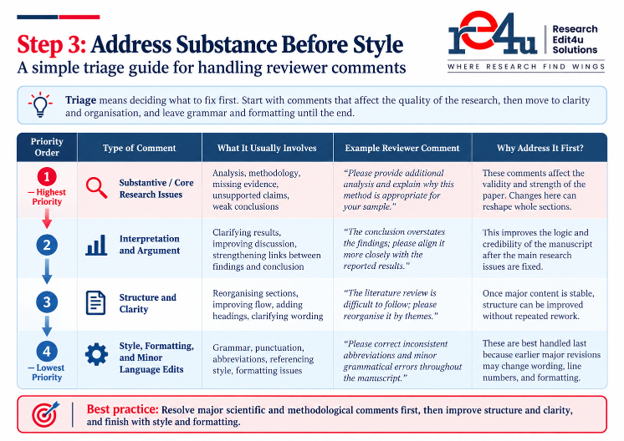
Put simply, it is a matter of sorting comments by what will reshape the paper versus what will simply polish it. Major revisions often reshape sections of the manuscript, which can in turn change line numbers, phrasing, and formatting throughout. Fixing the stylistic issues first, only to have them shift again once the substantive revisions are made, wastes a revision cycle.
Step 4: When the Right Response Is Disagreement
Not every reviewer comment should be accepted. Reviewers can misread a method, over-apply their own disciplinary conventions, or simply be mistaken about what the data show. Disagreement is a legitimate part of the response process, and a researcher is not obligated to accept every comment as written. What matters is that any pushback is presented respectfully and backed by evidence.
What disagreement should never look like is a flat assertion that the reviewer is wrong. A response that pushes back needs to do so with evidence: a citation, a re-run analysis, a clarification of what the manuscript actually says versus what the reviewer read into it. The tone matters as much as the substance. A respectful, well-supported pushback reads as confidence. A dismissive one reads as evasiveness, even when the underlying point is correct.
Example: a point-by-point pushback
Reviewer comment: The sample size appears too small to support the regression analysis presented in Section 4.2.
Author response: Thank you for raising this concern. We agree that sample size is an important consideration when interpreting regression results. However, we respectfully differ regarding the need to remove the analysis. The model includes three predictors with a sample of 146 observations, and the diagnostic checks did not indicate serious violations of the assumptions underlying the analysis. We have now clarified the sample-size justification and added the relevant diagnostic information in the Methods section (Page 8, Lines 214–227). We have also moderated the interpretation of the regression results in the Discussion to avoid making claims beyond what the data support.
Where multiple reviewers raise contradictory requests, that tension is worth naming directly in the response letter rather than quietly picking a side. Editors are generally in the best position to resolve a genuine conflict between two reviewers, and naming it explicitly invites them to do so.
Step 5: Writing the Actual Response Letter? (See template)
The response letter itself typically follows a point-by-point format, outlined below (a downloadable template following this same structure is linked at the end of this guide):
Open with a brief, genuine note of thanks to the reviewers and editor, even where some comments were difficult to receive.
Reproduce or closely paraphrase each comment, numbered to match the reviewer's own sequence.
Respond directly beneath each comment, stating plainly what was changed and where it can be found in the revised manuscript.
Use a clear visual separation between the reviewer's comment and the author's response, through formatting, indentation, or a two-column table.
Address every comment without exception, including the minor ones. An unanswered comment is one of the more common triggers for a follow-up query in the next round.
There is no fixed length for a response letter. It should run as long as the comments require, which in practice is often somewhere between three and ten pages. Brevity is a virtue here, but never at the cost of leaving a comment only partially addressed.
Step 6: When a Comment Crosses a Line
Most reviewer comments, even blunt ones, stay within the bounds of professional critique. Occasionally one does not. COPE's guidelines are direct on this point: reviewers are expected to avoid derogatory personal comments, unfounded accusations, and any language that functions as harassment rather than critique.
If a comment crosses from criticism of the work into something that reads as personal, biased, or inappropriate, the right move is not to absorb it silently or respond in kind. It is to raise the issue directly with the editor, referencing the journal's code of conduct or COPE's guidelines where relevant, and to request that the matter be addressed before the revision process continues.
Revision Is a Sign the Work Is Being Taken Seriously
A long list of reviewer comments can feel like rejection in slow motion. In practice, it is usually closer to the opposite. Reviewers who did not think a manuscript was worth the effort tend to write short, dismissive reports, or none at all. A detailed, demanding set of comments is frequently a sign that reviewers engaged closely with the work and want to see it published in its strongest possible form.
Responding well is less about having the perfect answer to every comment and more about demonstrating, comment by comment, that every concern was read, considered, and addressed on its merits.
Researchers preparing for their first round of reviewer comments, or working through a particularly dense set of them, often find it useful to have a second set of eyes check that nothing in the response letter has been missed or under-addressed before resubmission. A structured pre-submission review can also surface many of the issues reviewers tend to flag before a manuscript ever reaches them, reducing how much of this process repeats itself on the next submission.
Frequently Asked Questions
How long should a response to reviewers be?
There is no fixed length. A response letter should be as long as the comments require to be addressed clearly and completely, which in practice often runs three to ten pages depending on how many comments were raised and how substantial they are.
What order should reviewer comments be answered in?
The same order the reviewer or editor originally used. Number each response to match the original comment numbering, with each reviewer and the editor's comments kept in their own clearly labeled section.
Is it acceptable to disagree with a reviewer?
Yes. Disagreement is a normal part of the response process, provided it is supported with evidence, such as a citation, additional analysis, or a direct clarification of what the manuscript states. A disagreement without supporting evidence is unlikely to be persuasive.
What should be done about an unprofessional or biased reviewer comment?
It should be raised directly with the editor rather than addressed in the response letter itself, with reference to the journal's code of conduct or COPE's guidelines on reviewer conduct where relevant.