
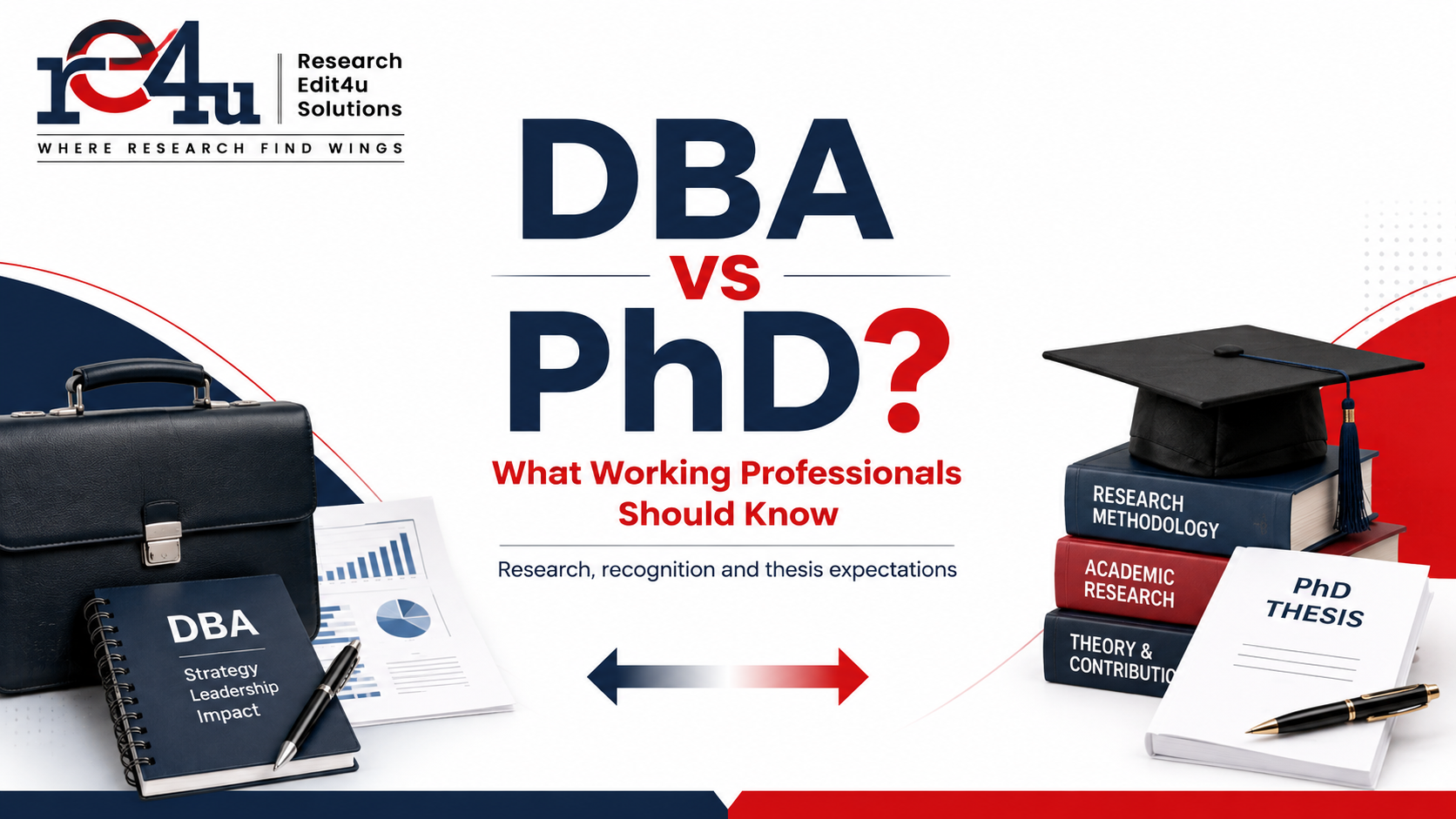
Did it ever cross your mind DBA or PhD? A simple short answer: a PhD in business or management is generally more strongly oriented towards theory development and academic research, while a Doctor of Business Administration (DBA) is designed for experienced professionals who want to investigate substantial business, management or policy problems happening at real world through doctoral-level research. The DBA is not simply a “higher MBA”, and it should not be treated as an easier route to a doctoral title. Both pathways can demand original research, methodological rigour, a substantial thesis or dissertation and an oral defence or viva, depending on the university.
DBA vs PhD in 30 seconds
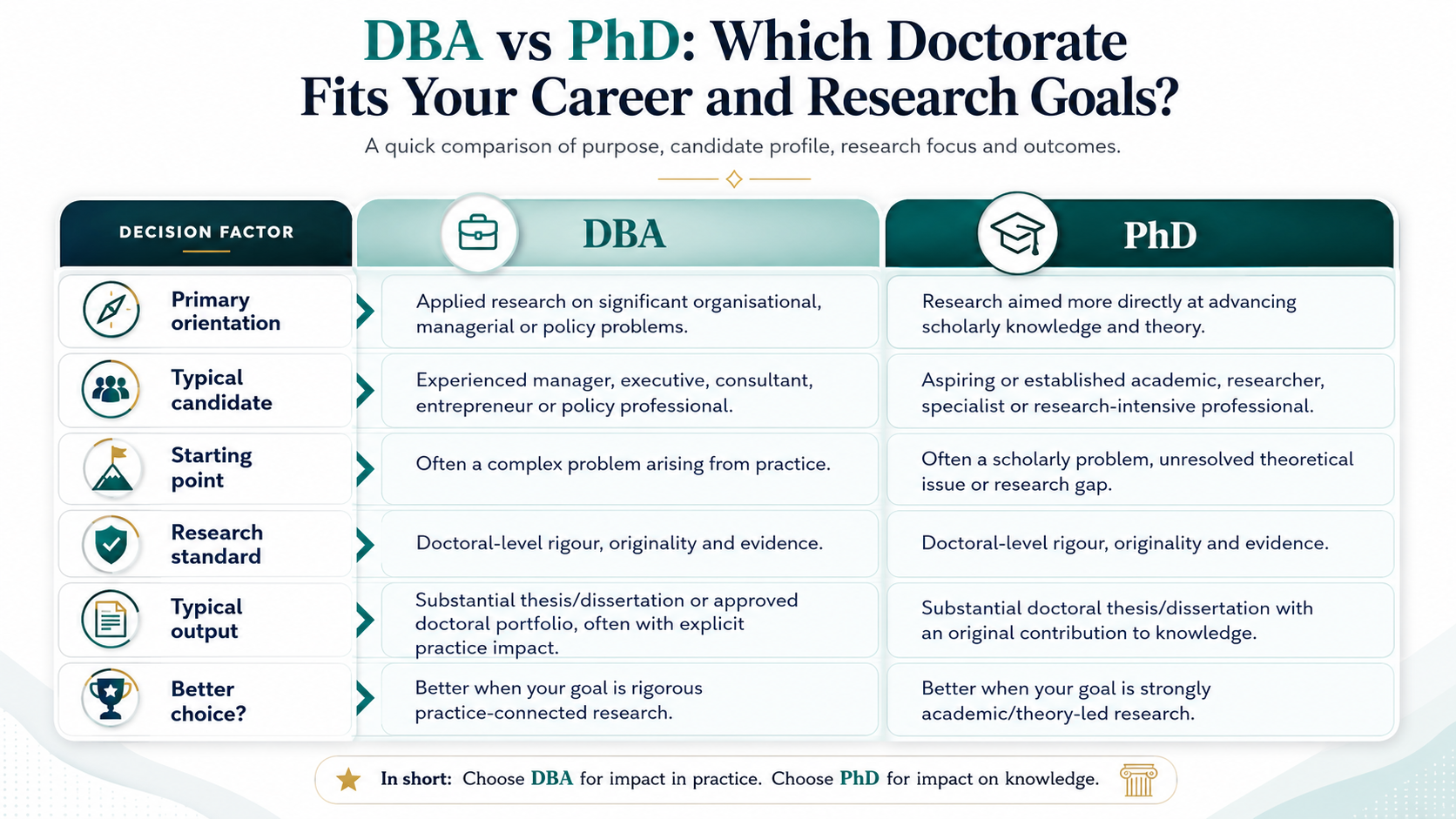
The important question is not “Which doctorate is higher?” It is “Which research architecture matches the contribution I want to make?”
Why are more working professionals talking about the DBA?
The DBA has become more visible in executive education, professional networks and social media because it offers something that many experienced professionals find attractive: the possibility of continuing a career while investigating a problem that matters to their organisation, industry or professional practice. Established business schools now describe the DBA explicitly as a research degree for senior professionals who want to connect academic theory with practice.
That attraction is understandable. After years in management, consulting, entrepreneurship, finance, healthcare, technology or policy, a professional may already have strong opinions about why an organisational problem exists. The doctoral challenge, however, is different: the candidate must turn experience into a researchable problem, justify the study in the literature, select defensible methods, analyse evidence and explain what the findings contribute.
This is why DBA interest, and DBA difficulty can rise at the same time. Professional experience helps identify meaningful problems. It does not automatically provide training in research design.
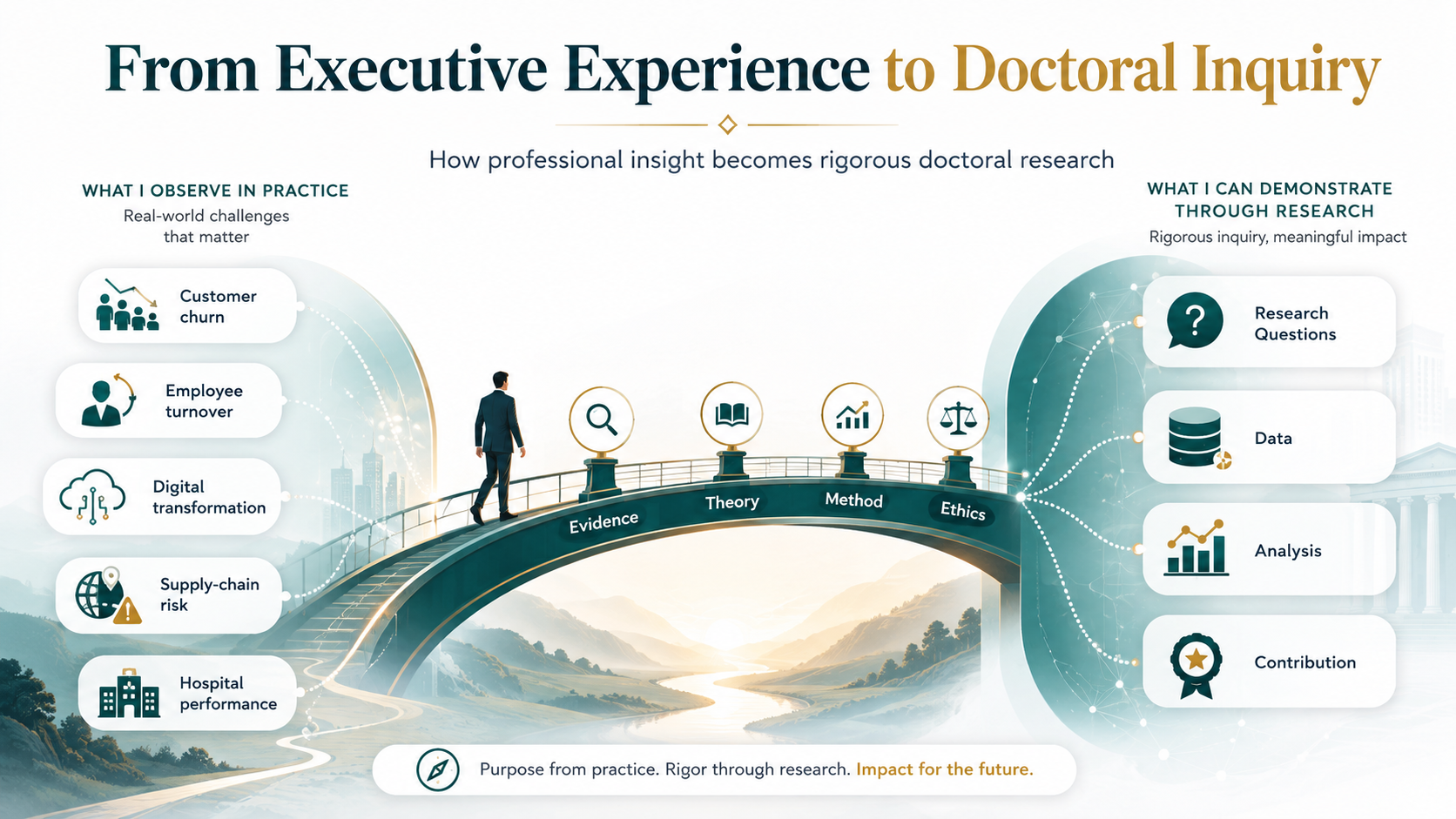
What is a DBA?
A Doctor of Business Administration is a professional doctorate in business and management. At established universities, it is designed for experienced professionals who want to undertake rigorous, original research with relevance to practice. The exact structure varies by institution: some programmes combine taught research-methods modules with a supervised dissertation; others use staged doctoral milestones, research projects and a final thesis or portfolio.
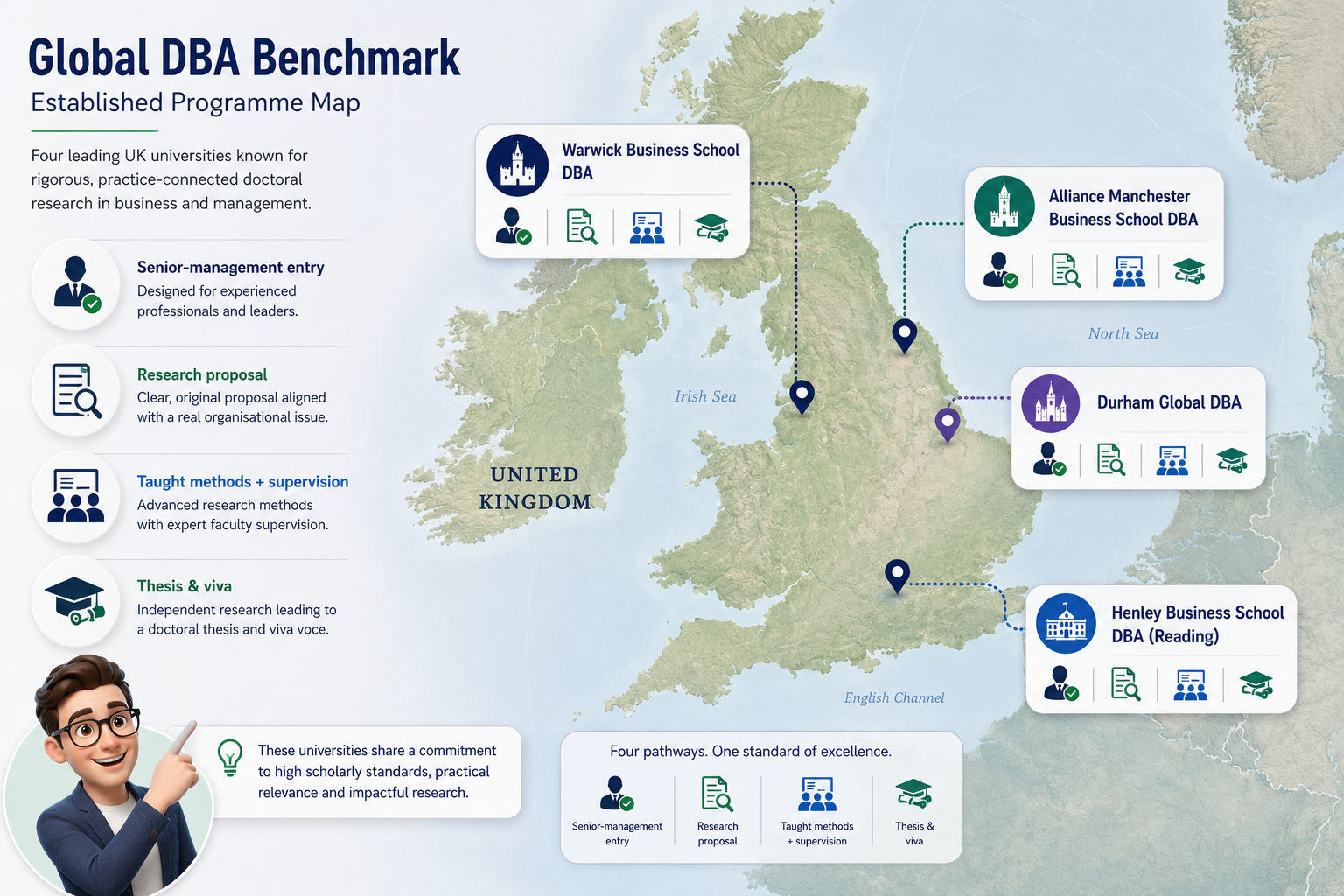
For example, Alliance Manchester Business School describes its DBA as “research in action” for senior-level professionals applying theory to practice. Henley Business School describes the DBA as a professional degree that develops and applies theory through rigorous and relevant research. Warwick Business School requires applicants to identify a specific organisational issue and submit a preliminary research proposal. These descriptions point to a common principle: the DBA is not simply advanced coursework. It is a research doctorate built around a defensible contribution.
What is a PhD in business or management?
A PhD is the conventional research doctorate. In business and management, it usually places greater emphasis on developing or extending scholarly knowledge, theory and research methods. A PhD candidate may study organisations and business phenomena, but the research is normally framed first as a scholarly problem rather than as an intervention into one candidate’s professional context.
The boundary is not absolute. A PhD can be highly applied, and a DBA can make a substantial theoretical contribution. The distinction is better understood as an orientation: DBA research generally gives explicit weight to practice and impact, while the PhD generally gives more weight to academic theory-building and a research career.
The real difference appears when you look at the research logic
A superficial DBA-vs-PhD comparison lists duration, fees and career options. A stronger comparison asks how each degree turns a problem into knowledge.
A simplified PhD logic may look like this: existing theory → unresolved scholarly problem → research gap → investigation → original theoretical or empirical contribution.
A simplified DBA logic may look like this: important professional problem → relevant scholarly knowledge → researchable problem → rigorous investigation → contribution to knowledge and practice.
The arrows matter. In a good DBA, “practical” does not mean anecdotal. The professional problem has to survive academic scrutiny. The candidate still needs literature, conceptual reasoning, data quality, methodology, ethics, analysis, limitations and a contribution that can be defended.
DBA in India: does it come under UGC?
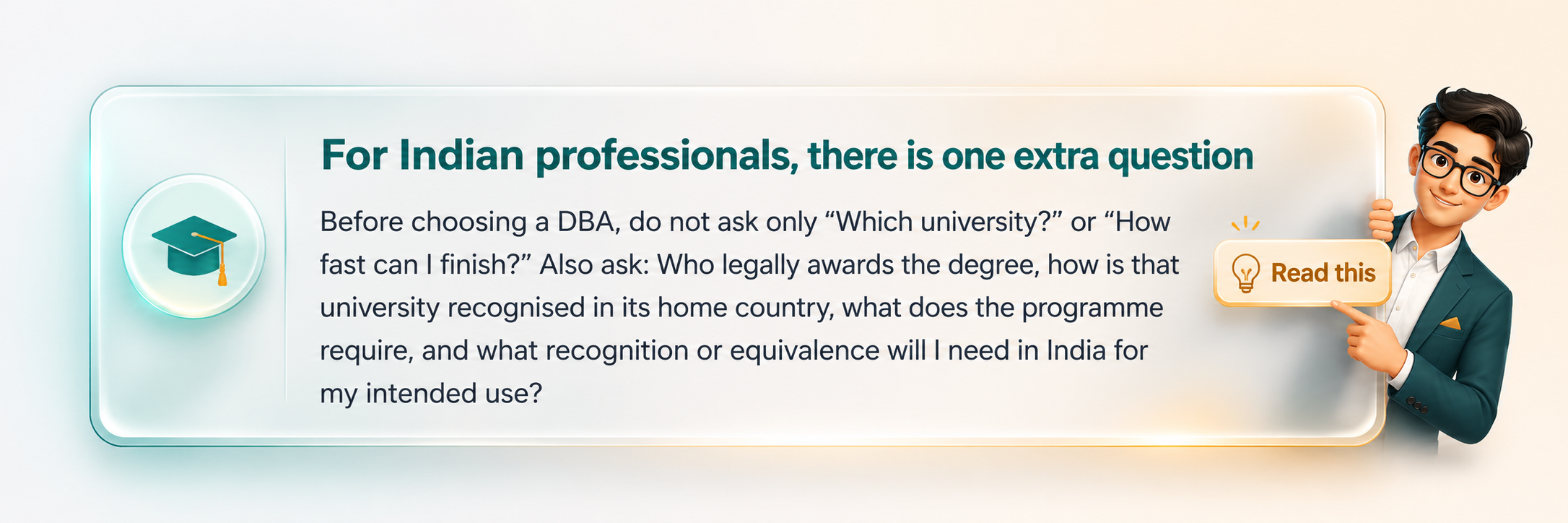
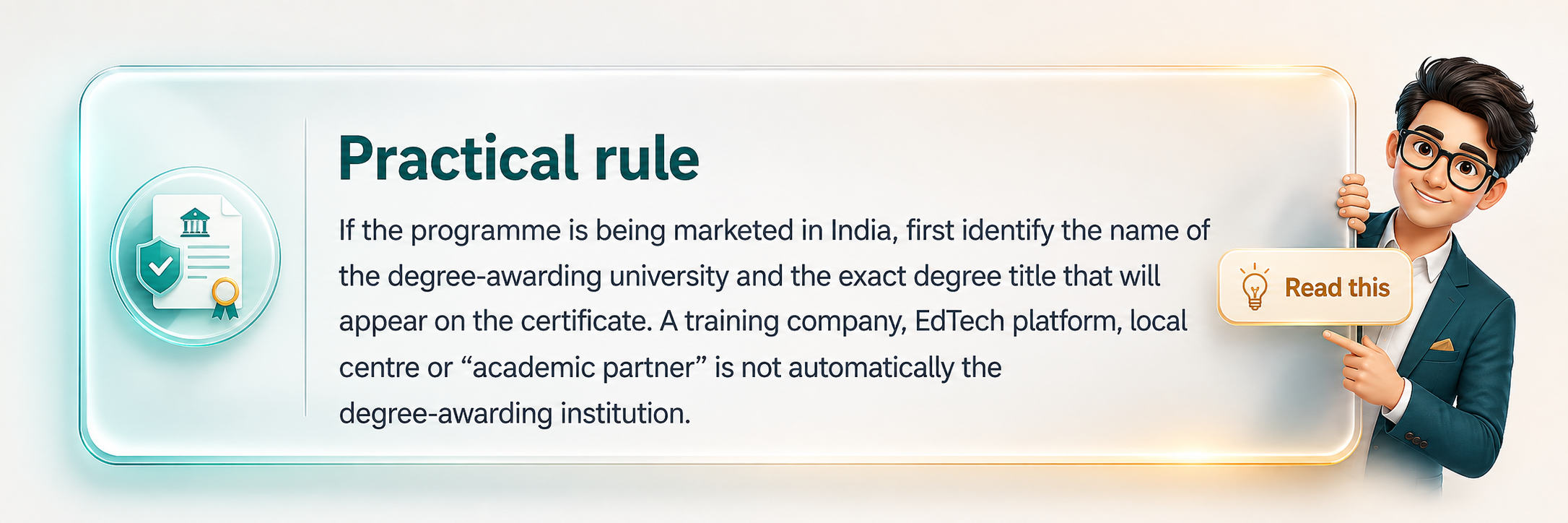
This is the section Indian applicants should read before paying a deposit.
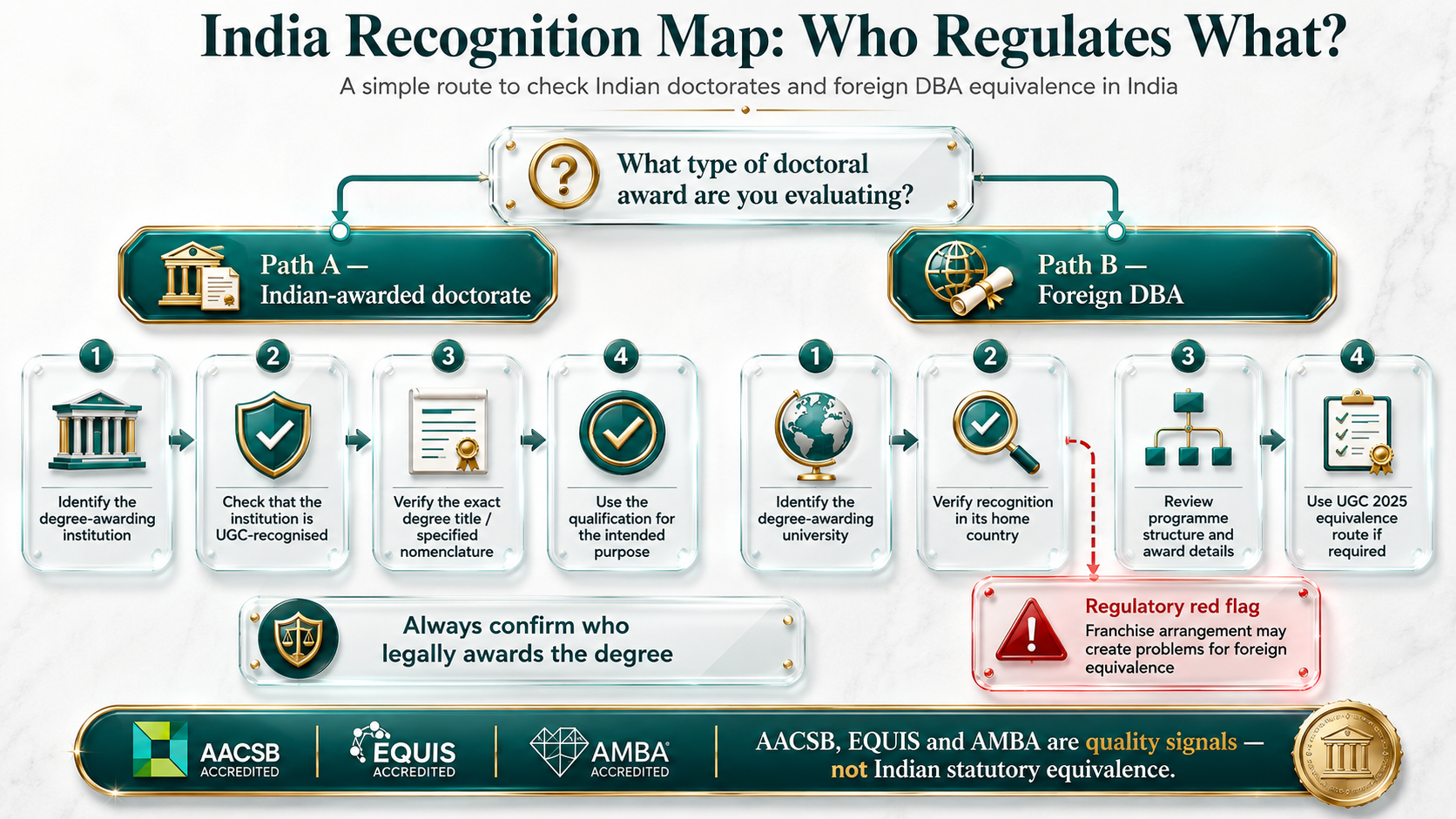
For degrees awarded by Indian universities, the University Grants Commission (UGC) Act and the UGC’s degree-specification framework are central. Section 22 of the UGC Act limits the right to confer degrees to universities or institutions legally empowered to do so. The UGC also publishes specified degree nomenclature for Indian higher education.
As of 8 August 2026, the UGC’s published degree-specification material available on its website lists “Ph.D. — Doctor of Philosophy” but does not list “DBA” or “Doctor of Business Administration” as a specified Indian degree nomenclature. That means an Indian provider using the label “DBA” should not be assumed to be offering a UGC-specified Indian university degree merely because the programme is described as doctoral.
What if the DBA is awarded by a foreign university?
This is a different question. In April 2025, the UGC notified the University Grants Commission (Recognition and Grant of Equivalence to Qualifications Obtained from Foreign Educational Institutions) Regulations, 2025 and created a dedicated Equivalence Portal.
Under those regulations, a foreign qualification can be considered for an equivalence certificate when, among other things, the foreign educational institution is duly recognised under the law of its home country, the student has pursued the programme according to the institution’s norms, and the entry-level requirements are sufficiently comparable to the corresponding Indian programme. The UGC’s review can consider programme duration or credits, evaluation processes, thesis or dissertation requirements and curricular outcomes.
The regulations also contain two safeguards that matter greatly in the DBA market. First, offshore-campus qualifications require appropriate approval in both the host country and the institution’s home country. Second, a qualification obtained through a franchising arrangement is not considered for recognition for grant of equivalence under these regulations.
So the correct answer to “Is a foreign DBA recognised in India?” is not a blanket yes or no. The correct answer is: check the awarding institution, home-country recognition, programme structure and the UGC equivalence requirements that apply to the qualification and your intended purpose.
Does AICTE recognise a DBA?
For the recognition question discussed here, the first issue is whether the award is a valid university degree and, for a foreign award, whether Indian equivalence is required. AICTE regulates technical education within its statutory remit, but an AICTE label is not a substitute for checking the legal status of the degree-awarding university or UGC equivalence. International business-school accreditations such as AACSB, EQUIS or AMBA may be useful quality signals, but they are also not substitutes for Indian statutory recognition or equivalence.
What about “100% online DBA” programmes?
Be particularly careful with this phrase. The UGC Distance Education Bureau currently states that research-based programmes such as M.Phil. and Ph.D. are prohibited through Open and Distance Learning and Online mode for Indian higher education institutions. That statement is about the Indian ODL/online regulatory framework; it should not be casually copied onto every foreign DBA. For a foreign DBA, the relevant questions remain the foreign university’s legal authority, the programme’s approved mode and structure, and the UGC foreign-qualification equivalence framework where equivalence is needed in India.
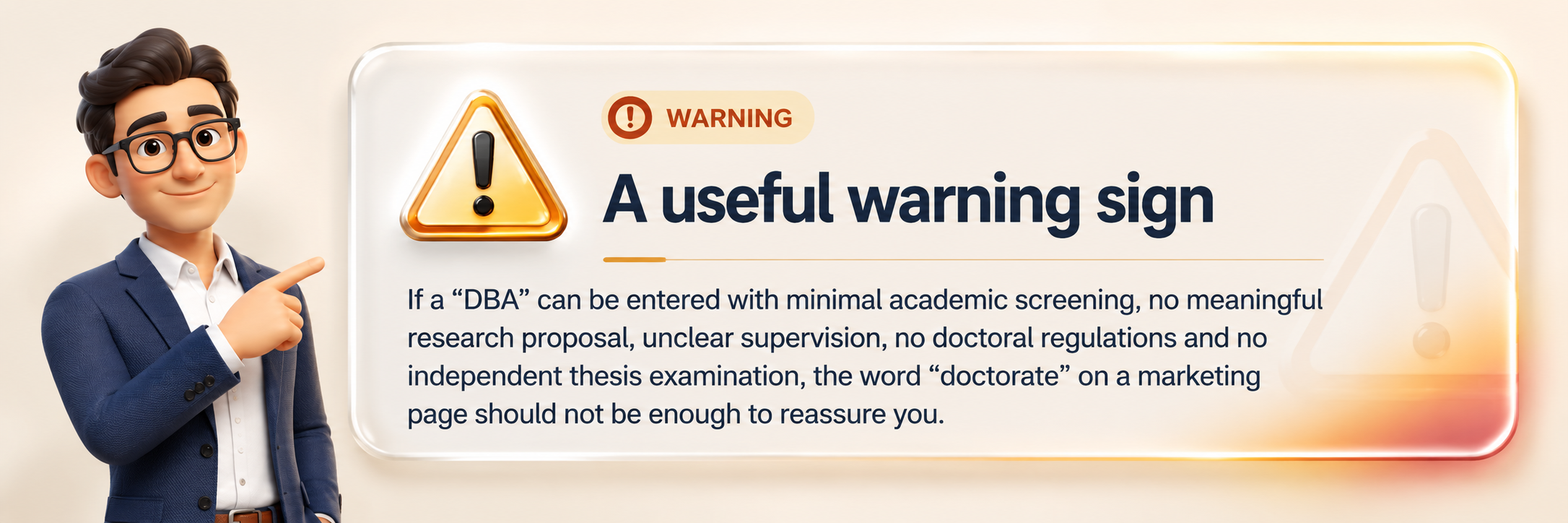
A red flag is a programme marketed as an international doctorate where the learner deals almost entirely with an Indian franchise or intermediary and cannot clearly identify the foreign university’s own admissions process, research supervision, doctoral regulations and thesis examination requirements.
Which DBA universities are worth benchmarking?
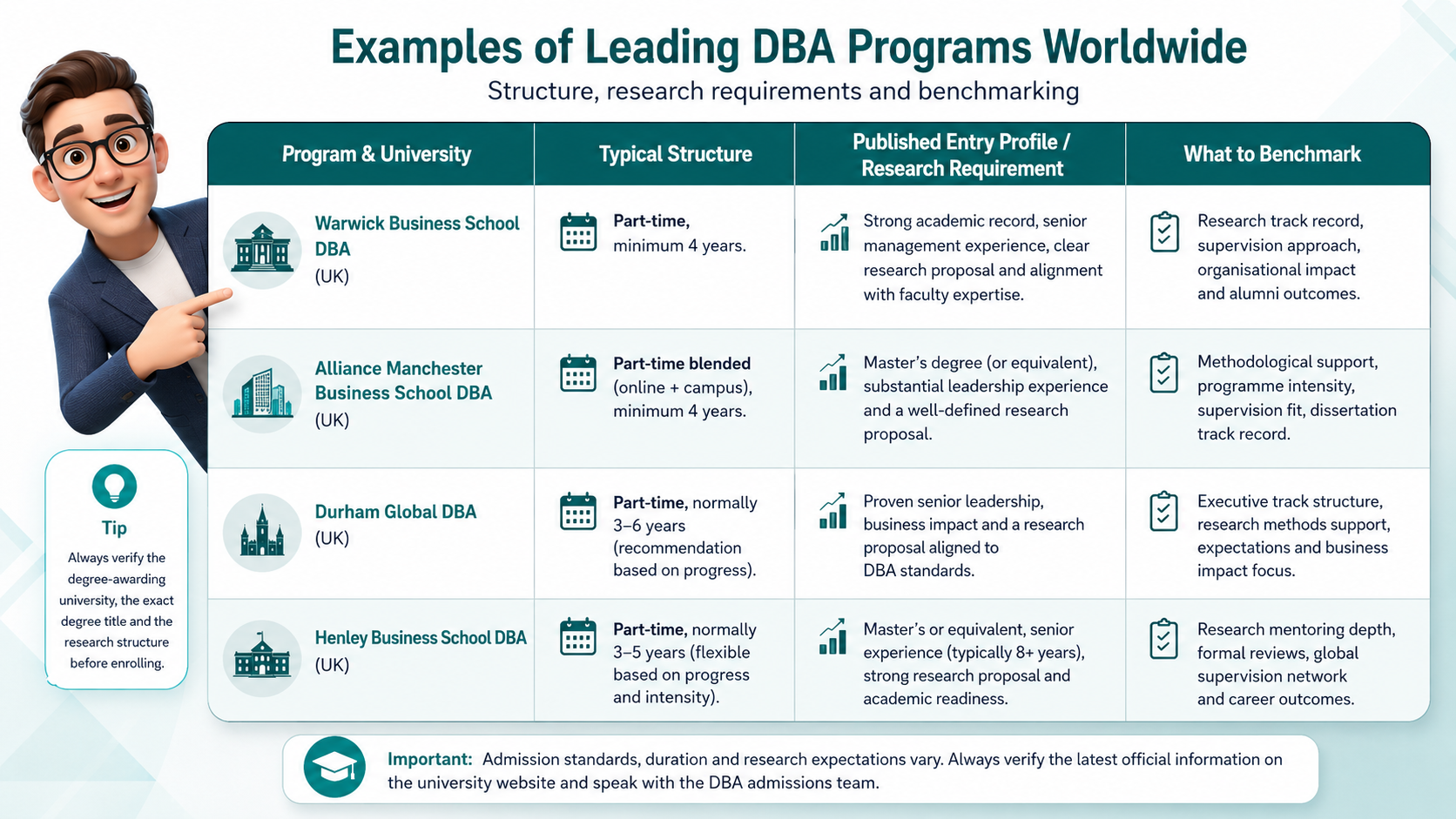
There is no single official global ranking that can tell every professional which DBA is “best”. A programme can be prestigious and still be the wrong fit if its research themes, supervision, attendance model, entry requirements or recognition pathway do not match your needs. A better approach is to benchmark established programmes and examine what serious doctoral requirements look like.
The following are examples of established university DBA programmes, not a ranking and not an endorsement for every applicant:
How should you evaluate a DBA programme before enrolling?
Before comparing fees, compare the research environment. A credible DBA should make it possible to answer the following questions clearly:
· Who legally awards the degree, and is that institution recognised in its home jurisdiction?
· What exact degree title appears on the final certificate?
· What academic and professional experience is required for admission?
· Does the application require a meaningful research proposal rather than only a CV and fee payment?
· How are research methods taught and assessed?
· How are supervisors assigned, and can the school supervise your proposed topic?
· What formal progression reviews or confirmation milestones are required?
· What original contribution must the thesis/dissertation demonstrate?
· Is there an oral examination/viva or equivalent doctoral defence?
· If you intend to use the degree in India, what recognition or equivalence will your specific purpose require?
What are the typical criteria to enter — and actually earn — a DBA?
Admission criteria vary, but established DBA programmes often expect both academic preparation and substantial professional experience. The examples above commonly require a master’s degree or MBA and around five to seven years of relevant management or senior-level experience. Several also require a research proposal before admission.
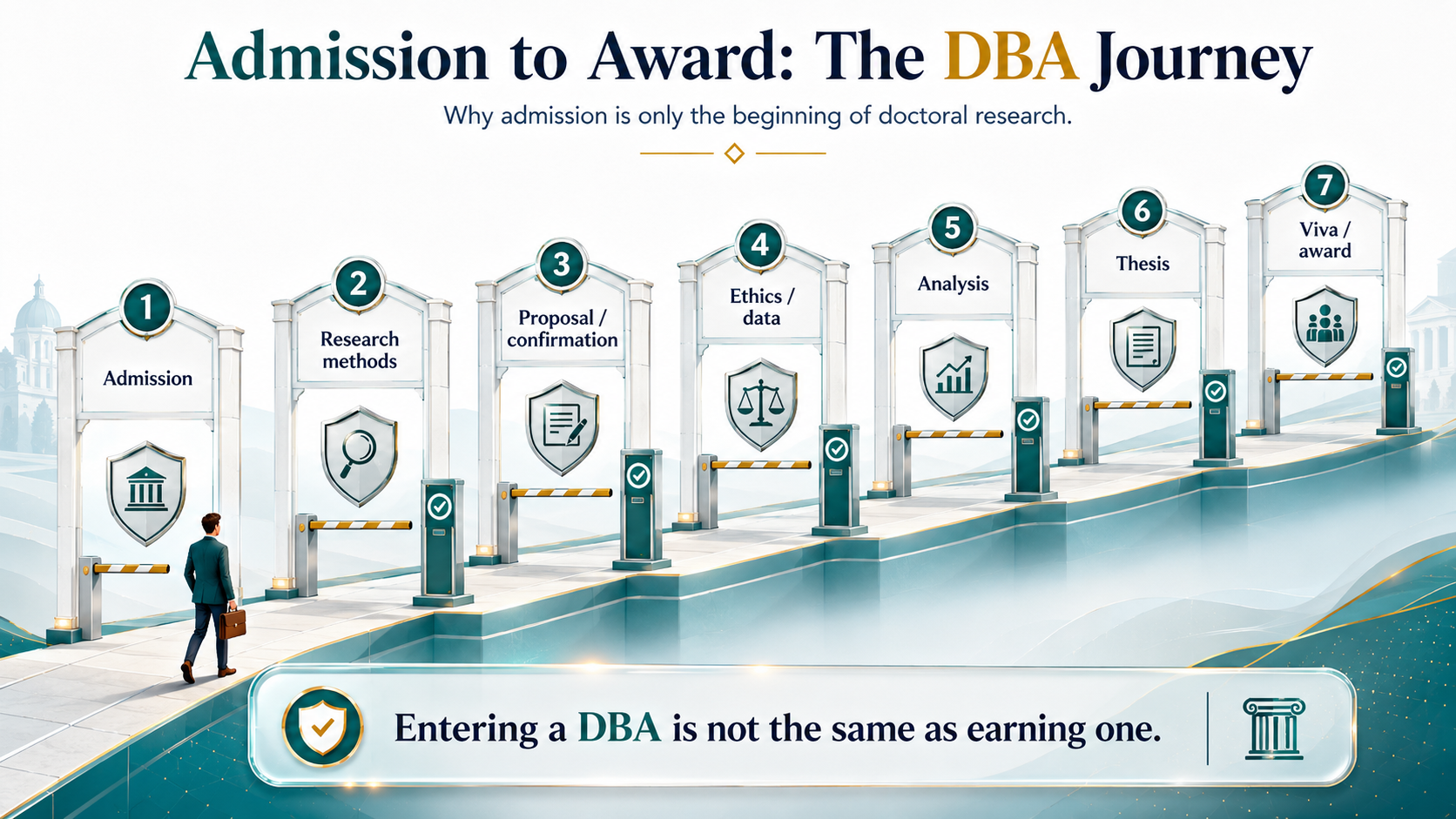
Getting admitted is only the beginning. A serious DBA normally includes multiple gates before the degree is awarded:
Stage | What the candidate may have to demonstrate |
1. Admission | Academic eligibility, professional experience, English-language competence where relevant, references, research potential and a viable proposal. |
2. Research training | Competence in literature review, research design, qualitative and/or quantitative methods, ethics and evidence-based reasoning. |
3. Progression / confirmation | A sufficiently developed problem, literature base, conceptual framework, research questions and feasible methodology. |
4. Data and research execution | Ethically obtained evidence, documented methods, appropriate analysis and defensible interpretation. |
5. Original contribution | A contribution that extends understanding and, in a DBA, normally has meaningful relevance to practice as well as scholarship. |
6. Thesis / dissertation | A substantial integrated research document or approved portfolio meeting the university’s doctoral regulations. |
7. Viva / oral examination | Ability to explain and defend the research choices, evidence, contribution, limitations and implications before examiners. |
This is why “How quickly can I get the degree?” is usually the wrong first question. The better question is “Can I sustain the research process required to earn it?”
What does a DBA thesis actually require?
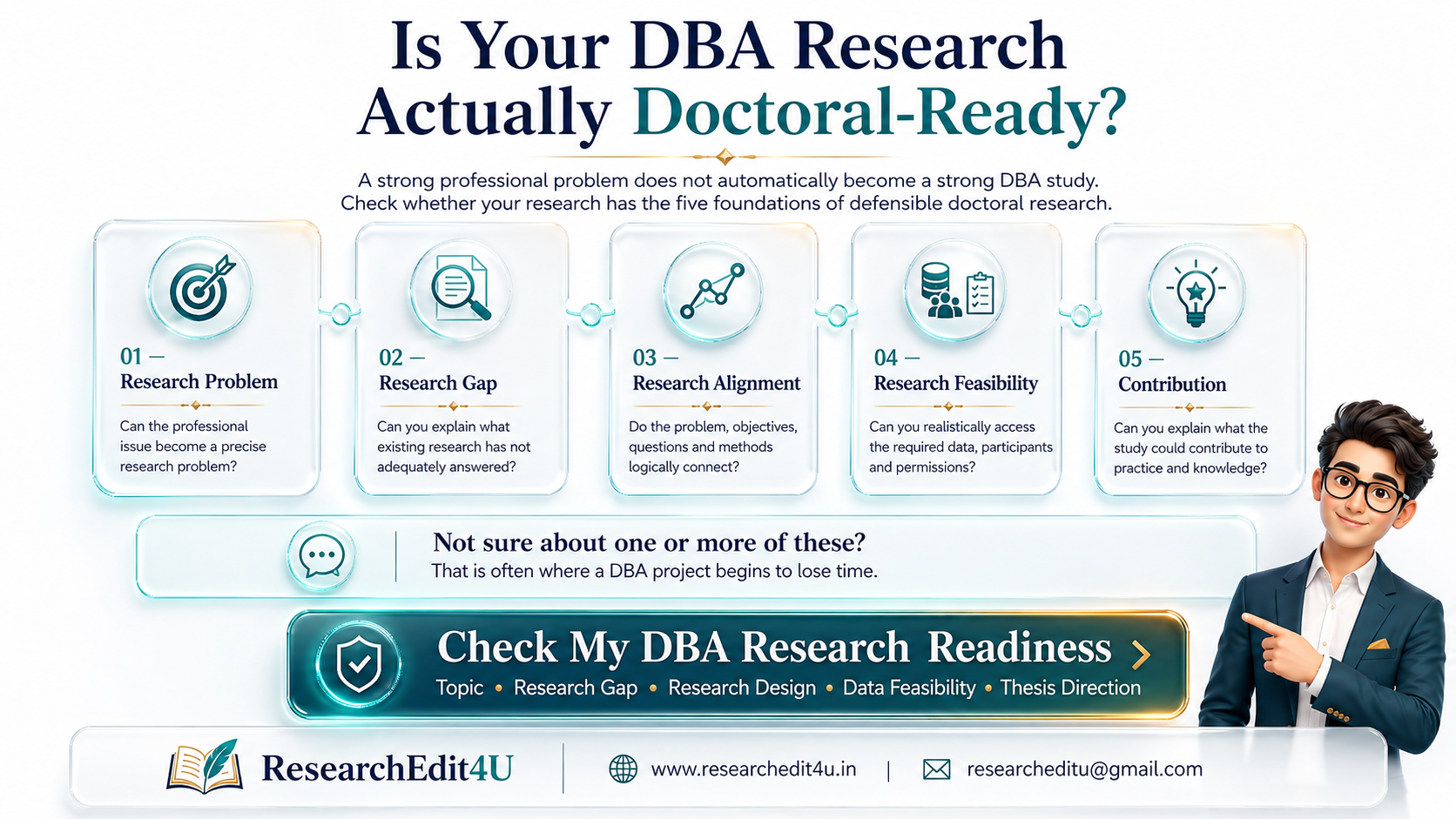
A professional problem becomes doctoral research only after it is translated into a question that can be investigated systematically. The most difficult work often happens before the candidate collects a single response or runs a statistical test.
1. Move from a business concern to a research problem
Suppose a manager says: “Our experienced employees are leaving even after salary revisions.” That is an important business concern, but it is not yet a doctoral research problem. The candidate has to ask what remains unexplained and what concepts could account for the pattern.
A research architecture might explore the relationships between leadership practices, employee engagement, organisational commitment and turnover intention. The exact model should come from literature and theory, not from a consultant drawing arrows that simply look plausible.
2. Identify a real research gap
“Very few studies exist” is not automatically a research gap. A stronger DBA gap may be contextual (what is unknown in a particular setting), theoretical (where a theory does not explain the phenomenon well), methodological (where prior designs leave uncertainty), population-based, contradictory in the evidence, or located between academic knowledge and professional practice.
3. Align the aim, objectives and research questions
The research problem, aim, objectives and questions should form one logical chain. If the objective says “to identify drivers”, the data and analysis must actually identify drivers. If the research question asks “how” people experience a process, a purely numerical survey may not answer it well. Misalignment here creates problems later in the methodology and findings chapters.
4. Build a theoretical or conceptual framework
Experience can suggest what matters. Theory helps explain why variables, mechanisms or behaviours may relate. A strong DBA uses theory as an analytical lens rather than adding a famous model to a chapter simply because doctoral theses are expected to mention theory.
5. Choose methodology after the question
Quantitative, qualitative and mixed-method designs can all be appropriate for DBA research. The methodology should follow the research question, evidence needs and underlying research logic, not the candidate’s familiarity with SPSS, SEM, NVivo or a particular technique.
A principle worth remembering Methodology should follow the research question — not the software the researcher already knows. |
6. Check data feasibility before committing to the topic
A brilliant topic can still fail if the data cannot be accessed. DBA candidates often study organisations, employees, executives, customers, financial records or policy settings where access, confidentiality and ethics matter. Before finalising the design, ask who controls the data, what permissions are required, whether the sample is realistic and what will happen if access is withdrawn.
7. Separate analysis from interpretation
Analysis tells you what the evidence shows. Interpretation explains what that evidence means in relation to the research question, theory, prior studies and the professional context. A thesis that reports coefficients, themes or tables without explaining their significance is not demonstrating the full intellectual work of doctoral research.
8. Make the contribution traceable to the evidence
DBA recommendations should not be generic management advice written after the results section. They should be traceable: finding → interpretation → implication → recommendation. The reader should be able to see why the proposed action follows from the research.
9. Be able to defend every important choice
The final test is not whether the thesis looks impressive. It is whether the scholar can explain why the problem matters, why the literature justifies the study, why the method fits, how the data were analysed, what the findings mean, what the limitations are and what contribution has genuinely been made.
Is a DBA easier than a PhD?
No — “different” should not be confused with “easy.” The DBA can be more compatible with a working professional’s career because many programmes are designed for part-time study and applied research. But the candidate still has to produce doctoral-level work. In fact, senior professionals can face a distinctive difficulty: they must temporarily stop relying only on managerial judgement and learn to justify decisions through research evidence.
A professional with twenty years of experience may immediately “know” why a problem exists. Doctoral research asks a harder question: what evidence would allow another informed person to evaluate that explanation?
Who should choose a DBA instead of a PhD?
A DBA may be a better fit if you are an experienced professional who wants a doctoral project to remain closely connected to a substantial organisational, managerial, industry or policy problem. A PhD may be a better fit if your primary aim is an academic research career, sustained theory development or a research question that is not anchored to your professional practice.
Neither answer is automatically superior. “Better” depends on the purpose of the doctorate, the research problem, the intended career use and the recognition requirements that matter to you.
Why experienced managers can still struggle with DBA research
Business expertise and research expertise are not the same skill. Senior professionals may already be excellent at judgement, strategy, finance, leadership, operations and decision-making. Doctoral research adds a different set of demands:
· framing a problem as a researchable question rather than a management complaint;
· searching and synthesising academic literature rather than collecting useful articles;
· using theory to explain mechanisms rather than decorating the literature review;
· justifying sampling, measurement and research design;
· distinguishing statistical significance from practical significance;
· developing qualitative themes without cherry-picking quotations;
· connecting results back to the research questions and theory;
· writing limitations that are intellectually honest without undermining the entire study;
· explaining the research clearly enough to defend it before supervisors and examiners.
10 reasons DBA researchers get stuck
1. The topic is professionally interesting but academically broad. “Digital transformation in banking” may be relevant, but it is not yet a sufficiently bounded doctoral problem.
2. The business problem has not become a research problem. A symptom, such as declining retention, must be translated into an unanswered question that evidence can address.
3. The gap is asserted, not demonstrated. A credible gap emerges from a structured reading of the literature, not from the sentence “few studies have examined this topic”.
4. Objectives and questions do not align. When the verbs, constructs, population or causal logic change between sections, the methodology becomes unstable.
5. Theory is missing or ornamental. Without an explanatory framework, a thesis can become a large report rather than a doctoral argument.
6. Methodology is selected too early. Choosing SEM, regression or interviews before clarifying the question can force the study into the wrong design.
7. Data access was assumed. Organisational permissions, respondent access, confidentiality and sample size can become the real bottleneck.
8. Analysis is disconnected from the questions. A technically correct output is not useful if it does not answer the stated research question.
9. The discussion repeats the findings. Doctoral discussion should interpret, compare, explain and theorise — not narrate the table again.
10. The contribution is vague. “This study will help managers” is not enough. The thesis should state exactly what is learned, for whom, under what conditions and with what limitations.
What our experience supporting a completed DBA research journey reinforced
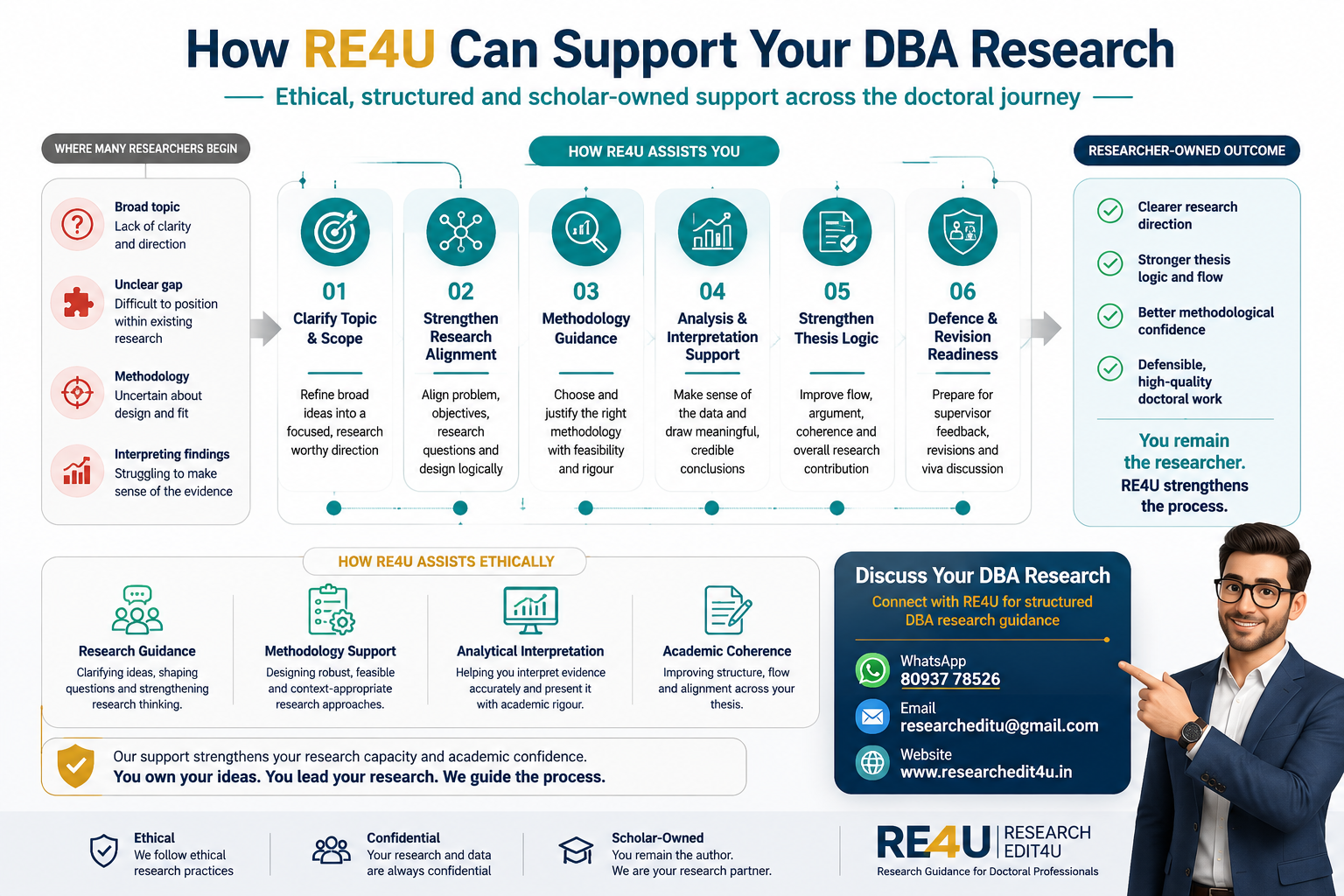
ResearchEdit4U has supported a DBA scholar through a completed thesis journey. We do not publish the scholar’s identity, institution or confidential research details. The useful lesson for prospective candidates is structural: professional knowledge is valuable, but it becomes doctoral research only when the researcher can explain the chain from problem → literature → question → method → evidence → contribution.
That is also why good research support should not replace the scholar’s ownership of the work. The candidate has to understand and defend the decisions. Research guidance, methodological review, data-analysis support, structural editing and supervisor-comment diagnosis are most useful when they make the scholar’s reasoning clearer and more defensible.
This reflects ResearchEdit4U’s published ethics-first position: support is advisory, editorial and technical; authorship and final academic responsibility remain with the researcher.
Is a DBA equivalent to a PhD in India?
Do not treat equivalence as automatic. Many foreign universities describe their DBA as a doctoral research degree comparable in academic level to a PhD but different in orientation. India’s regulatory question is separate. For a foreign qualification, the UGC’s 2025 regulations provide a case-by-case equivalence mechanism. If you need the qualification for higher education, research, public employment or a position whose rules specifically mention a PhD, verify the requirement before relying on marketing language such as “equivalent to PhD”.
If your goal is purely professional development in the private sector, an employer may evaluate the qualification differently from a university recruitment committee. If your goal is an Indian academic appointment, promotion or admission where “Ph.D.” is explicitly prescribed, obtain clarity from the relevant university/employer and, where applicable, the UGC equivalence process.
A 10-minute due-diligence check before you pay a DBA fee
· Open the degree-awarding university’s own website — not only the recruitment partner’s landing page.
· Find the official doctoral regulations or programme handbook.
· Confirm the exact award title: Doctor of Business Administration, PhD, or something else.
· Confirm admission standards and whether the university itself evaluates the applicant.
· Check whether a research proposal is required and whether supervisor fit is assessed.
· Find the thesis/dissertation requirement and whether an oral examination is required.
· Check the university’s legal recognition/accreditation in its home jurisdiction.
· If delivery occurs through an offshore campus, verify the campus approval status.
· If an intermediary uses “franchise”, “validation centre” or similar language, examine the arrangement carefully.
· For planned use in India, check current UGC equivalence requirements before assuming the degree will satisfy a specific PhD requirement.
Frequently asked questions about DBA vs PhD
Is a DBA a doctorate?
At recognised universities that are legally authorised to award it, a DBA is a doctoral qualification. The important verification is the awarding institution, the programme’s doctoral requirements and the recognition needed in the country where you intend to use the degree.
Is a DBA the same as a PhD?
They can sit at the same doctoral qualification level in some higher-education systems, but they are not the same programme. The DBA is normally more practice-oriented; the PhD is normally more theory/research-career oriented. In India, do not infer automatic equivalence from this general comparison.
Is a DBA higher than an MBA?
A genuine DBA is a doctoral qualification and therefore represents a different academic level and research requirement from an MBA. It is not simply “MBA Part 2”; the decisive difference is original doctoral research.
Can I pursue a DBA after an MBA?
Yes, many established DBA programmes expect an MBA or other master’s degree plus substantial professional experience. Entry rules vary by university, and competitive programmes may also require a strong research proposal and interview.
Is a DBA easier than a PhD?
Not necessarily. A DBA may fit a working professional better, but it still requires doctoral-level research, originality, methodological justification and a defensible thesis or dissertation.
Does a DBA require a thesis?
Many established DBA programmes require a substantial thesis/dissertation and an oral examination or viva. Some universities may allow an approved doctoral portfolio or alternative format. Always check the official regulations of the programme.
How long does a DBA take?
Established part-time DBA programmes commonly publish timelines in the four-to-six-year range, although the exact duration depends on the university, research progress and mode of study.
Can a DBA be qualitative?
Yes. Qualitative, quantitative and mixed-method designs can all be appropriate. The research question and evidence needs should determine the design.
Is a DBA recognised by UGC in India?
That question needs precision. The UGC’s published Indian degree nomenclature lists Ph.D. but not DBA. For a DBA awarded by a foreign university, the UGC’s 2025 foreign-qualification regulations provide an equivalence route subject to eligibility and review. Do not assume automatic recognition.
Can a DBA holder use “Dr.”?
A genuine doctoral award may permit use of the doctoral title according to the awarding institution’s conventions, but the use of “Dr.” does not itself prove UGC equivalence or eligibility for a post in India. Recognition and job eligibility should be checked separately.
What makes a strong DBA research topic?
A strong topic sits at the intersection of professional importance, an identifiable research gap, a suitable theoretical basis, feasible data access, ethical viability, appropriate methods and a contribution that can be defended.
When should a DBA scholar seek research support?
The highest-leverage points are often before the topic is locked, when supervisor feedback reveals misalignment, before data collection, before selecting analysis methods, and when the findings/discussion are not answering the original questions. Support should strengthen the scholar’s own research decisions and remain within institutional academic-integrity requirements.
Your DBA Research Should Be Defensible—not Just Completed.
You may already have the professional experience, a promising topic, or even several thesis chapters. The important question is whether your research problem, gap, objectives, methodology, evidence and contribution work together as one defensible doctoral study.
RE4U can help you identify where the research logic needs strengthening—while keeping the thinking, decisions and final research scholar-owned.
Request My DBA Research Review →
Share your DBA stage, proposed topic and current research concern.
Topic clarity • Research gap • Objectives & questions • Methodology • Analysis • Thesis logic • Supervisor revisions
Ethical research guidance • Confidential support • Scholar-owned research
WhatsApp: 80937 78526
Email: researcheditu@gmail.com
Website: www.researchedit4u.in