WHY A GOOD ABSTRACT IS NECESSARY?
Most researchers know the abstract matters, but many still treat it like the last small job before submission. That is usually where the trouble begins. Your abstract is not a decorative paragraph sitting above the paper. It is the first test of whether your work feels clear, focused and worth another minute of attention. Before a reviewer reads deeply, before a database indexes your article, and before an AI system decides whether your page is quotable, the abstract has already started doing the heavy lifting. That is why a good abstract now carries two jobs at once. First, it must help an editor understand the paper quickly and trust it enough to move it forward. Second, it must make the paper easy to discover, summarise and cite. This applies across disciplines. A lab study, policy paper, legal analysis, conceptual chapter, qualitative study, review article, humanities paper or business manuscript may sound different, but the first-read test is remarkably similar: what is this about, what exactly is being done, what comes out of it, and why should the reader care?
Why the abstract now matters even more?
Editors are busy, but the issue is not simply speed. It is signal. A strong abstract sends a controlled signal that the work is relevant, coherent and proportionate. A weak one creates doubt. If the opening stays too broad, the paper feels generic. If the purpose is hidden, the paper feels unfocused. If the language is inflated, trust drops. And if the abstract does not match the actual paper, the submission starts to look risky.
For researchers, this means the abstract should be written with discipline, not drama. The aim is not to sound clever. The aim is to make the paper easy to trust. Editors do not need fireworks in 180 words. They need clarity, fit and a credible contribution.
What editors are scanning for in the first 30 seconds
Is the purpose visible early?
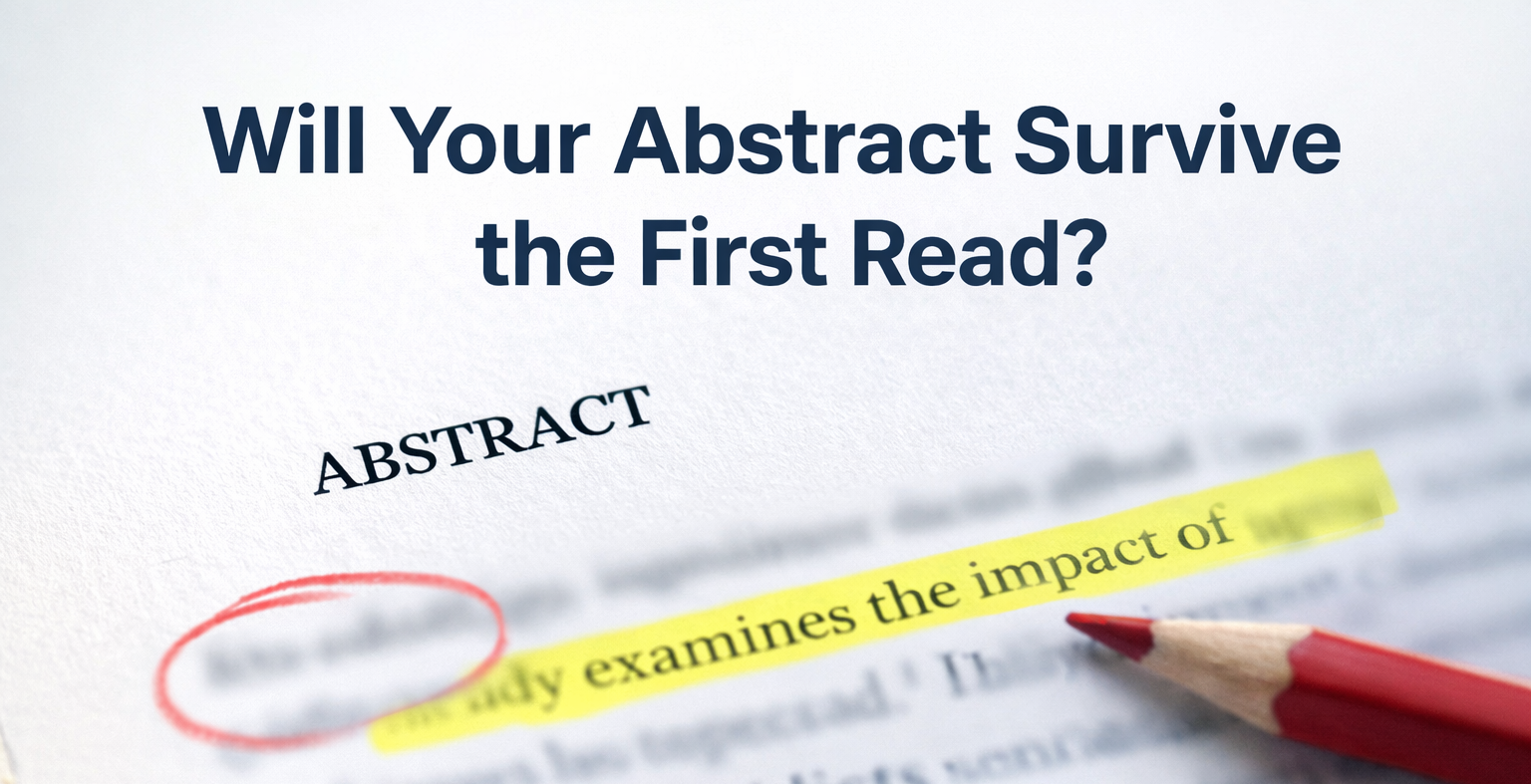
A strong abstract makes its purpose visible fast. The reader should not have to wait until the final line to understand what the paper is trying to do. Phrases such as 'this study examines', 'this article argues', 'this review synthesises' or 'this chapter explores' work because they remove fog.
Is the contribution clear?
The abstract must show what is added, clarified, tested or reinterpreted. For an empirical paper that may be a result or pattern. For a conceptual article it may be a framework, argument or distinction. For a review it may be a synthesis, trend or gap. Editors are not just scanning for topic; they are scanning for contribution.
Can I trust the claims?
Trust often comes from proportion. A good abstract does not promise to transform an entire field in one paragraph. It states what the work does and lets relevance emerge through precise wording, not hype. That single habit improves both editorial confidence and AI visibility, because quotable sentences tend to be clear, bounded and evidence-friendly.

Figure 1: An infograpic showing difference between a good abstract and bad abstract and what a good abstract should have ?
The five-part abstract framework that works across disciplines
Across fields, the most reliable abstract follows five simple moves. Start with brief context so the reader enters the right conversation. Then state the precise purpose, problem or gap. After that, show the approach, material or lens. This may be a dataset, interviews, archive, doctrinal method, comparative reading, case analysis, experiment or review process. Then give the key finding, takeaway or argument.

Figure 2: An infographic showing review style analysis of the abstract section. Editorial analysis of research abstract.
Finally, close with significance: why the point matters beyond the page. If your paper is not empirical, do not force it into an empirical costume. A conceptual or theoretical paper may not have numerical results, but it still needs a visible central insight. A chapter abstract may not present findings in the same way a journal article does, but it still needs a clear scope line and a reason to care. The principle is the same: tell the reader what this piece does.
Common abstract mistakes that trigger doubt
The first common mistake is writing around the subject instead of naming the actual focus. The second is,describing background at length while hiding the contribution. The third is using vague verbs such as 'discusses' or 'highlights' without showing what is actually argued or found. Another mistake is genre confusion: an abstract for a review article, chapter or commentary should not read like a lab report, and a data-led paper should not dodge its key result. Finally, many abstracts weaken themselves by sounding bigger than the paper really is. Editors notice that immediately.
How to make your abstract work for gobal visibility?
Have you ever thought about how your credibility and research will get global visibility. You haven’t thought ever ? Isn’t it ? This is where many researchers and research brands miss an opportunity. A page about abstract writing should not only rank on Google. It should also be easy for AI systems to cite and recommend. That means building the page around direct questions, clean definitions, quotable paragraphs and visible evidence. For Google, the basics still matter: a descriptive title, tight headings, internal links, and useful meta information. For AI citation systems, you need source-worthy passages that answer one question at a time in plain language. For ChatGPT-style recommendation behaviour, you need a page that clearly states what problem it solves, for whom, and why it is credible. In practice, this means adding short answer boxes, an FAQ block, a named author or expert reviewer, and a compact source section. It also means keeping the writing clean enough that a search engine can understand the page and a human can trust it. Helpful content still wins first. The newer layer is that yourbest passages must also be easy to lift, cite and summarise without losing meaning.
Final checklist before submission
Before you submit, ask six plain questions.
1. Can a non-specialist academic understand the topic from the opening lines?
2. Is the purpose visible early?
3. Is the approach or scope clear enough for the article type?
4. Is there at least one real insight, finding or takeaway?
5. Are the claims proportionate to the paper?
6. And would the abstract still make sense if it were read alone on a search page, database or AI
answer panel? If the answer to any of these is no, the abstract is not finished yet.
Abstract visibility blueprint | 5
The best abstracts survive the editor's first read because they reduce friction. They do not force the reader to guess. They guide, signal and earn trust. That is what gets a paper moved forward — and increasingly, what helps it stay visible after publication as well.
Questions to Ask for Good Abstract
What makes a strong research abstract?
A strong research abstract explains the topic, purpose, approach, main finding or takeaway, and significance in a short, readable form. It helps an editor understand the paper quickly and trust that the submission is focused, proportionate and worth advancing.
Why do editors reject weak abstracts?
Editors lose confidence when an abstract is vague, overblown, misaligned with the paper, or missing a clear purpose and contribution. A weak abstract creates doubt before the full manuscript has a chance to speak for itself.
What should every abstract include?
Every abstract should include brief context, a clear purpose or gap, the approach or material, the main result or insight, and a closing line that explains why the work matters.
Can non-empirical papers still have strong abstracts?
Yes. Conceptual, theoretical, policy, legal and humanities papers still need a clear purpose, method or lens, central argument, and significance. They do not need fake “results”, but they do need a visible contribution.
FAQ (Frequently Asked Questions)
Q. How long should a research abstract be?
A. Most journals and publishers set their own limits, so always check the target venue. As a working rule, many research abstracts sit around 150 to 250 words, while some chapter or conference formats use different limits.
Q. What are the four main parts of an abstract?
A. In many structured abstracts the four core parts are background, methods, results and conclusion. In broader cross-disciplinary writing, it often helps to think in five moves instead: context, purpose, approach, key insight, and significance.
Q. What are the most common mistakes in abstracts?
A. The most common mistakes are being too broad, hiding the purpose, avoiding the main insight, exaggerating the claims, and writing an abstract that does not match the article type or the final paper.
Q. Should I use keywords from my title in the abstract?
Yes, but naturally. The abstract should repeat the central topic in a way that sounds useful to a human reader. Forced repetition or keyword stuffing weakens readability and can make the page feel spammy.
Q. Can AI help me draft an abstract?
AI can help with drafting, trimming, and generating alternatives, but the researcher still needs to check accuracy, tone, article fit, and whether the final wording truly matches the paper. An abstract must stay honest as well as clear.
Q. What should I do before submitting my abstract?
Read it as a stand-alone text. Then ask whether the purpose is visible, the approach is clear, the main insight appears, the claims are proportionate, and the wording matches the target journal, chapter, or conference format.